
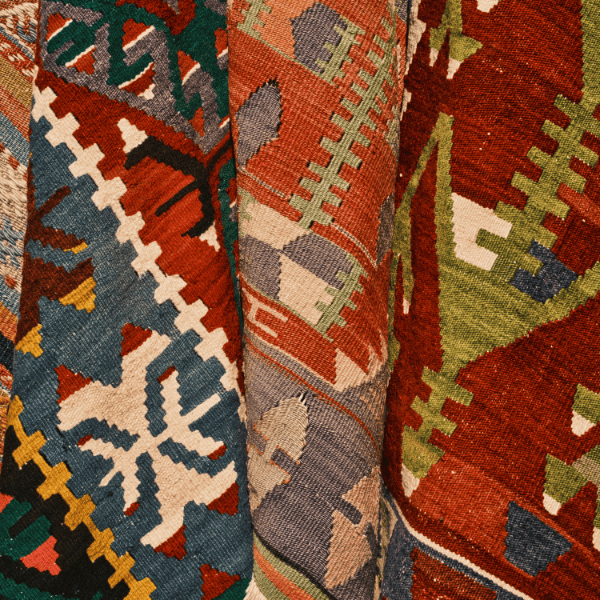
A vintage kilim rarely disappears into a room. Its handwoven geometry, softened wool, and subtle irregularity give it a point of view. The pleasure of a vintage kilim decorating guide is not in making every color or motif match. It is in learning how to let a piece with history set the emotional temperature of the space around it.
Kilim rugs are flatwoven rather than piled, traditionally made across regions including Anatolia, Persia, the Caucasus, and Central Asia. Their graphic motifs and often lively palettes can feel remarkably current, but they bring a depth that newly made décor cannot imitate. A well-chosen vintage kilim gives a quiet, tailored room texture; in a more collected interior, it can become the thread that holds disparate pieces together.
Start With the Room, Not the Rug Alone
A kilim may be beautiful in isolation and still be wrong for the room. Before falling for a particular pattern, consider the architecture, existing upholstery, light, and how the room is used. A sunlit family room with linen upholstery can carry a more saturated field of rust, indigo, or saffron. A quieter bedroom may call for a faded small-scale pattern that feels restful underfoot.
Scale is usually the first decision. In a living room, the rug should feel generous enough to connect the seating rather than float in the center like a postage stamp. Ideally, the front legs of sofas and chairs sit on the rug, with enough visible border around the arrangement to give the room room to breathe. In a dining room, allow roughly 24 to 30 inches beyond the table edge so chairs remain on the rug when pulled back.
Because kilims are flatwoven, they are especially useful where doors need clearance or where a thick pile would feel cumbersome. Hallways, kitchens, entries, and layered bedrooms all benefit from their low profile. In high-traffic spaces, a vintage piece with naturally softened color can be particularly forgiving.
Use Color as a Conversation, Not a Match
The most successful kilim rooms rarely rely on exact color matching. Instead, pull one or two tones from the rug and repeat them lightly elsewhere: a clay-red stripe in a pillow, a faded blue in artwork, a warm ivory in curtains or painted woodwork. This approach makes the room feel composed without looking overly coordinated.
A multicolored kilim can be a useful starting point for a restrained palette. Let its quieter shades lead. A rug with red, charcoal, camel, faded pink, and blue might suggest warm white walls, walnut furniture, charcoal lampshades, and a single blue upholstered chair. The rug provides complexity; the larger surfaces stay calm.
If your room already contains strong color, choose a kilim with enough neutral ground to create relief. Cream, oatmeal, tobacco, and softened gray are not secondary notes in a vintage rug. They are often what allow a bolder motif to live comfortably with patterned drapery, art, or upholstery.
Let patina do some of the work
Vintage kilims often show abrash – the gentle variation in color created by hand-dyed wool and shifts in the weaver’s yarn supply. This tonal movement is part of the appeal. It makes a rug feel less fixed, and often more adaptable, than a perfectly uniform new textile.
Do not mistake gentle fading, small repairs, or slight irregularity for a flaw that needs to be concealed. These details can lend a room its sense of ease. That said, condition should suit placement. A more delicate antique or a kilim with visible wear may be better in a low-traffic bedroom, layered beneath a larger natural-fiber rug, or displayed as textile art rather than placed in a busy entry.
Build Contrast Around the Weave
Kilim decorating becomes most interesting when the surrounding materials offer contrast. The crisp geometry of a flatweave looks beautiful against the rounded forms of a slipcovered sofa, a carved wood table, plaster walls, or a nubby bouclé chair. It also brings welcome softness to rooms with stone, metal, glass, or clean-lined contemporary furniture.
Avoid repeating the same visual energy everywhere. If the rug is intricate, choose upholstery with a solid or quietly textured surface. If the room is mostly tailored and neutral, a graphic kilim can introduce rhythm without requiring more decorative objects. The goal is balance, not a themed interior.
Dark wood and vintage kilims are a natural pairing, particularly when the rug contains warm reds, brown-black accents, or golden wool. But pale oak, painted furniture, and contemporary silhouettes can work just as well. A kilim does not require an overtly traditional room. Its handmade character often gives modern spaces the warmth they are missing.
A Vintage Kilim Decorating Guide by Room
Living rooms
Use a larger kilim as the anchor beneath a seating group, particularly when the furniture is upholstered in linen, velvet, leather, or a simple performance fabric. A kilim can support a layered room without making it feel precious. Add cushions sparingly, choosing one pattern that speaks to the rug and leaving the rest in solids or subtle stripes.
For a smaller vintage kilim, consider placing it at an angle beside a reading chair, under a narrow bench, or over a larger neutral rug. Layering is especially effective when the kilim is too special or too small to carry the whole floor plan alone. A jute or wool base gives it visual scale while allowing its pattern to remain the focal point.
Dining rooms
A flatweave kilim is practical beneath a dining table because chairs move easily across it. Choose a design with a relatively even field or an allover repeat rather than a strongly centered medallion that may be hidden by the table. Deep indigo, charcoal, brick, and mixed earthy colorways can also be more forgiving in rooms where meals are served.
The trade-off is that a lightweight kilim may shift under active chairs. A properly sized rug pad is essential, both for safety and for preserving the weave. It adds cushioning without changing the rug’s clean, low-profile character.
Bedrooms
In a bedroom, a vintage kilim can feel more personal than formal. Place a large rug under the lower two-thirds of the bed, or use matched-scale runners on either side if you prefer more exposed flooring. The pattern will be partially covered, so favor a piece whose color and texture matter as much as its central motif.
A narrow kilim at the foot of the bed brings warmth to a simple upholstered frame. In guest rooms, it can be the element that makes a pared-back space feel considered rather than merely furnished.
Hallways and entries
Runners are where kilims often show their most immediate charm. Their elongated format suits historic hallways, galley kitchens, and narrow passages, while the pattern introduces movement to otherwise overlooked architecture. Leave a modest border of flooring visible around the runner, and make sure doors clear the weave before committing to a size.
An entry is a good place for color, but it is also a demanding environment. Select a sturdier piece with an allover design, use a nonslip pad, and accept that a handmade vintage rug will develop further character through use. If preservation is your highest priority, reserve the most delicate examples for gentler spaces.
Choose Pattern With Confidence
A busy kilim is not necessarily difficult to decorate around. What matters is visual scale. Large, open motifs tend to read calmly from across a room, while tightly repeated symbols can feel more active even in muted colors. Consider the amount of pattern already present in your wallpaper, curtains, art, and upholstery before deciding which direction the rug should take.
For interiors with traditional bones, a kilim with a time-softened palette can keep the room from becoming too formal. In newer homes, sharper geometric motifs can introduce structure and history. Neither approach is more correct. The right piece is the one that creates tension in a pleasing way: old against new, tailored beside tactile, patterned alongside plain.
When selecting one-of-a-kind textiles, photographs are only part of the process. Ask about pile, condition, material, dominant colors, and how the rug feels in person. At Eskici Rugs, that conversation is part of the curation: the best recommendation begins with your room’s proportions, light, and the life the rug will live within it.
Give the Rug a Life It Can Sustain
A vintage kilim is made to be used, but thoughtful care protects both its beauty and its structure. Use a rug pad, rotate it periodically where sun exposure is uneven, and address spills promptly by blotting rather than rubbing. Avoid harsh chemical cleaners and be cautious with heavy furniture legs, which can stress a flatweave over time.
Most of all, resist the impulse to make a vintage kilim behave like a perfect new object. Its slight asymmetry, softened dyes, and traces of human making are precisely what allow it to bring warmth to a room. Let it carry the history it has, then let it gather a little of yours.