
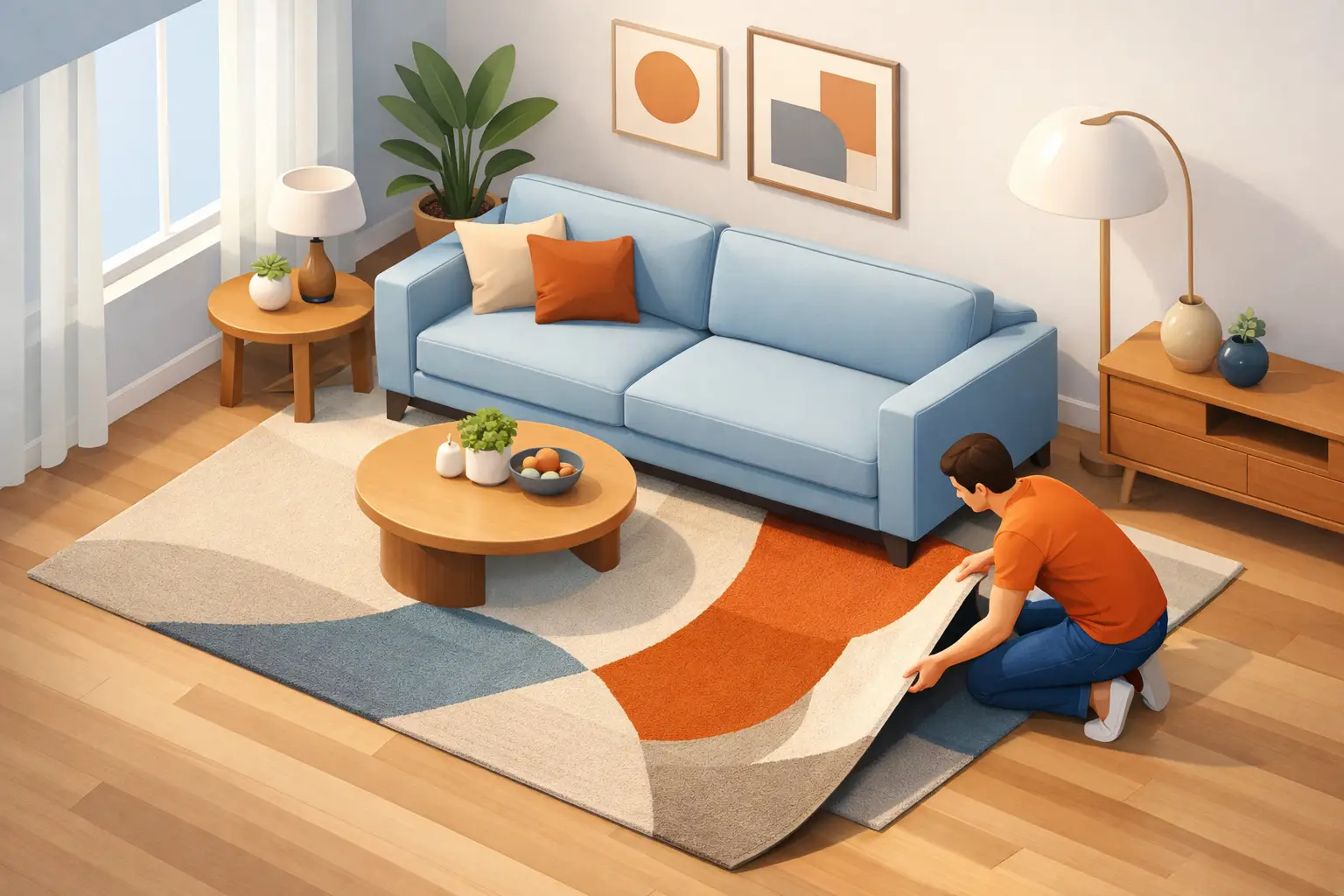
A rug can make a sofa look considered or oddly adrift. The difference is rarely the color alone. It is the relationship between the rug’s edges, the sofa’s feet, the room’s architecture, and the pathways people use every day. Knowing how to place a rug under a sofa gives a living room its visual center, allowing a distinctive handmade piece to bring warmth and quiet character without feeling crowded.
For a vintage or antique rug, this decision matters even more. Its softened palette, irregular nuances, and woven history deserve enough visible surface to be appreciated. The goal is not to hide a beautiful textile beneath furniture, but to let it anchor a beautifully layered room.
How to Place a Rug Under a Sofa: Start With the Room
Before moving the sofa, look at the room as a whole. Identify its natural conversation area: usually the zone formed by the sofa, chairs, coffee table, and fireplace or media wall. The rug should define that zone rather than simply sit beneath one piece of furniture.
Measure the width and depth of the seating arrangement, not only the sofa. Then consider the clear floor around it. In a generously proportioned living room, aim to leave roughly 12 to 18 inches of exposed floor between the rug’s outer edge and the walls. In a smaller room, 6 to 10 inches can feel balanced. These are guides rather than rules. A room with an architectural hearth, deep built-ins, or an unusual footprint may call for a more tailored approach.
A rug that is slightly too large is usually more forgiving than one that is too small. Undersized rugs tend to make furniture appear disconnected, particularly when the sofa is substantial or the room has high ceilings. When a handmade rug is the piece with the strongest sense of texture and provenance, generous scale lets it do its work.
Choose the Right Sofa Placement
There are three reliable ways to position a rug beneath a sofa. The best choice depends on room size, rug dimensions, and how formal or relaxed you want the arrangement to feel.
Put all sofa legs on the rug
This is the most expansive and settled option. The entire sofa sits on the rug, with enough depth remaining behind it that the back legs do not crowd the edge. Ideally, the rug extends 8 to 12 inches beyond each side of the sofa, though more is welcome in a large room.
Use this approach when the seating area floats in the center of the room or when you are working with a large rug, often 9 by 12 feet or larger. It creates a clear, composed foundation for a room with multiple chairs, a large coffee table, or a pair of facing sofas. It is particularly effective for open-plan spaces, where the rug needs to establish a distinct living area within a larger expanse.
The trade-off is practical: a larger handmade rug is a greater investment, and its dimensions may be less flexible in a future home. Yet for a principal living room, the visual calm is often worth it.
Place only the front legs on the rug
For many homes, this is the most versatile answer. Set the rug beneath the front legs of the sofa by approximately 6 to 10 inches. The rug should still extend beyond both sofa arms and reach far enough into the room to hold the coffee table and, ideally, the front legs of nearby chairs.
This placement feels intentional without requiring the largest possible size. It works beautifully when a sofa rests against a wall and the room needs a grounded center rather than a fully floating furniture plan. A 8 by 10 rug is often well suited to this arrangement, although the actual sofa width and chair placement should guide the final decision.
Make sure the front legs are truly on the rug, not merely touching its border. A narrow overlap can look accidental and may cause the rug edge to curl or shift over time. The sofa should appear connected to the textile, not perched on it.
Keep the sofa off the rug
A sofa can sit just beyond the rug’s edge, but this is the most exacting arrangement. Leave a deliberate gap of several inches between the sofa and rug, rather than allowing the edge to meet the feet. This can work in a compact room, with a small-scale sofa, or when a rare accent rug is being used as a focused textile composition beneath a coffee table.
The risk is fragmentation. If the rug does not reach the chairs or coffee table in a meaningful way, it may read as an island rather than an anchor. In most living rooms, placing at least the sofa’s front legs on the rug will create a more unified result.
Let the Rug Extend Beyond the Sofa
The rug should almost always be wider than the sofa. A minimum extension of 6 inches on each side can work in a tight room, but 8 to 12 inches feels more relaxed and visually generous. This extra width gives the eye a sense of completion and helps frame side tables, lamps, and occasional seating.
Length matters just as much. A coffee table should sit entirely on the rug, with enough surrounding area for people to place their feet comfortably. If chairs face the sofa, their front legs should generally meet the rug as well. The result is a cohesive group rather than a collection of individual furnishings.
There are thoughtful exceptions. An unusually long antique runner or a narrow vintage rug may be better used alongside a sofa, in front of a built-in bench, or in a passage where its proportions can be honored. Forcing a one-of-a-kind rug into the wrong layout diminishes both the room and the textile.
Consider Pattern, Pile, and Visual Weight
Placement is also about what the rug contributes once the furniture is in position. A richly patterned Persian, Sultanabad, or Oushak rug can support a neutral sofa with remarkable ease, but enough of the field and border should remain visible to preserve its composition. If the sofa hides most of a defined border, shift the rug forward or select a larger size.
A softer, open-field rug offers more flexibility beneath upholstered furniture, especially in a room already layered with art, books, and collected objects. A detailed rug, by contrast, can bring order to a restrained interior. Neither choice is inherently better. The right balance depends on whether the room needs visual depth or a moment of rest.
Pile height deserves attention, too. Low-pile vintage rugs are often ideal under sofas because the furniture sits securely and doors or nearby drawers are less likely to catch. A rug pad remains essential, even under a heavy sofa. It cushions the weave, reduces movement, and helps protect both the rug and the floor beneath it.
Work With Real-Life Clearances
A beautiful layout should still allow a room to function. Maintain comfortable walking paths around the seating area, generally 30 to 36 inches where traffic is frequent. Avoid placing a rug edge directly in a main route, where it can become a visual interruption or a tripping point.
If the sofa is against a wall, do not feel compelled to push the rug all the way behind it. In most cases, stopping the rug beneath the front legs is cleaner and uses the rug’s dimensions more efficiently. If the sofa floats, however, letting the rug extend beneath all four legs creates a more finished view from every angle.
When working with a sectional, use the outer footprint rather than the shorter return as your guide. The rug should extend beyond the longest visible side and reach beneath the front feet of both sections. This prevents the sectional from visually overwhelming the rug.
Test the Layout Before Committing
Painter’s tape is one of the simplest design tools available. Mark the proposed rug dimensions on the floor, then stand at the room’s entrance and view the outline from several angles. Walk around it. Open doors. Notice whether chair legs land naturally within the shape.
This exercise is especially useful when selecting a handmade rug with nonstandard dimensions. Antique rugs may vary slightly from their stated size, which is part of their authenticity. Measuring the actual available floor area, rather than shopping by a standard size alone, gives you a clearer path to a piece that feels chosen for the room.
A sofa and rug should not compete for attention. Together, they should create an inviting foundation for conversation, texture, and the objects that make a home personal. Give the rug enough room to be seen, let the sofa connect it to the seating area, and allow the slight irregularity of a handmade textile to bring its own composed warmth to the room.
[…] a living room, the most assured arrangement usually places at least the front legs of sofas and chairs on the rug. A larger rug that holds the full seating group is often more generous still, […]