
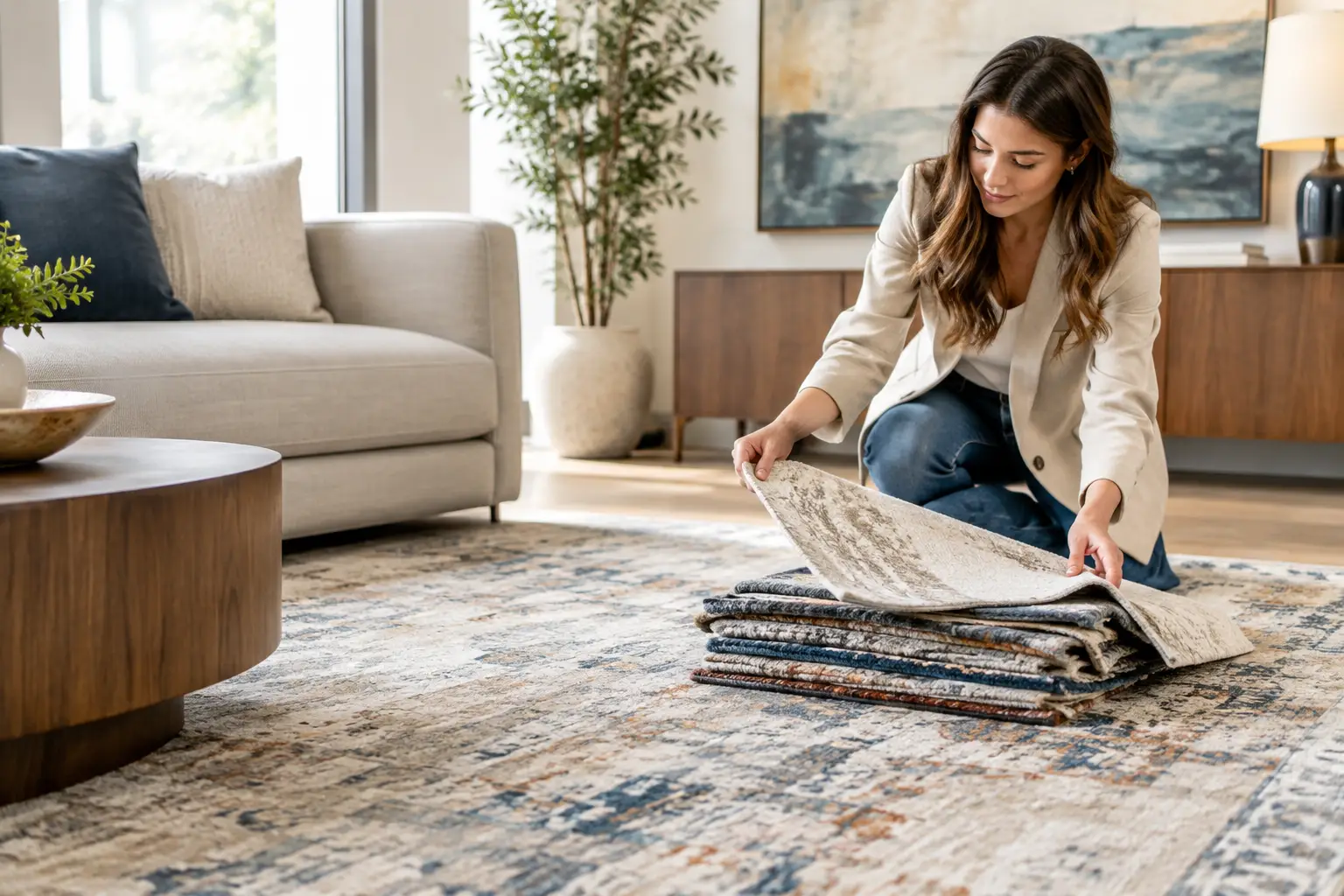
A rug is often selected late in a project, after the upholstery, lighting, and paint have already made their case. Yet thoughtful designer rug procurement works best when it begins much earlier. A handmade rug is not merely a finishing layer. It establishes scale, softens architecture, brings a room’s materials into conversation, and gives a carefully composed interior the quiet character that makes it feel lived in.
For a decorator or homeowner, the challenge is rarely finding rugs. The challenge is finding the right singular piece among an enormous, uneven market – one with the proper proportions, an honest material story, and enough visual depth to live beautifully with the room for years.
Begin Designer Rug Procurement With the Room
Before considering a weave, palette, or origin, define what the rug must do. In a living room, it may gather a seating arrangement and make an open plan feel settled. In a dining room, it needs to frame the table while allowing chairs to move with ease. In a bedroom, its role may be more tactile: softness underfoot on the first step into the day.
Dimensions should come from the furniture plan, not from the sizes currently available. A rug that is too small can make even beautiful furnishings appear scattered. For most living rooms, the front legs of sofas and chairs should rest on the rug at minimum; a more generous room may allow the entire arrangement to sit within its borders. In a dining room, plan for at least 24 inches beyond the table on every side, so chairs remain on the rug when pulled back.
This discipline is especially useful when sourcing vintage and antique rugs, whose dimensions may be wonderfully idiosyncratic. A 9-by-12-foot rug is not interchangeable with an 8-by-10, and a handwoven piece may vary slightly from its stated size. Measure the room, tape out the footprint, and note door swings, floor vents, hearths, and major circulation paths. A clear brief prevents a beautiful but impractical purchase.
Build a Brief That Leaves Room for Discovery
The best sourcing briefs are precise without being restrictive. Include the target size, budget range, room function, dominant materials, and the colors that must remain in balance. Then identify the feeling you want the room to hold: airy and pale, grounded and earthy, tailored and graphic, or layered with old-world warmth.
Avoid specifying every color in the rug before the search begins. Handmade textiles are compelling because they introduce nuance that a paint chip cannot predict: softened madder red, tobacco brown, faded indigo, apricot, ivory, and the subtle variation of undyed wool. A room often becomes more convincing when the rug gently complicates the palette rather than repeats it exactly.
For trade projects, photographs of the space, finish samples, furniture elevations, and a floor plan are more useful than a broad request for “something neutral.” They allow a knowledgeable source to assess not just color, but scale, density of pattern, and whether a rug needs to recede or carry the room.
Understand What You Are Buying
A handmade rug has a presence that goes beyond its pattern. Wool absorbs and reflects light differently from synthetic fiber, acquiring a softness that works especially well alongside linen, wood, plaster, and stone. Cotton foundations, silk details, and mixed materials each bring different qualities, but wool remains a natural choice for much of residential life because it is resilient, tactile, and forgiving.
Construction matters, although it should not become a shorthand for quality. Hand-knotted rugs are valued for their durable structure and intricate patterning. Flatweaves offer a lower profile and a more relaxed, graphic effect. Handwoven vintage pieces may show abrash, the organic shifts in color created by different dye lots or batches of wool. These variations are not flaws. They are evidence of process, and often the very details that give a room warmth.
Age also requires a more thoughtful reading. An antique rug may have gentle wear, repaired areas, patina, or irregular edges. These characteristics can be deeply appealing in an interior that values texture and history. They may be less suitable, however, for a space demanding a crisp, formal surface or for a household that expects perfect visual uniformity. Procurement is not about chasing the oldest rug or the finest knot count. It is about matching the textile’s character to the life of the room.
Regional Traditions Offer Useful Design Cues
Knowing a few weaving traditions helps refine a search without reducing a rug to a label. Turkish Oushaks are often admired for their spacious motifs, softened palettes, and generous scale, making them natural companions to layered, relaxed interiors. Sultanabads can bring a larger, more open floral vocabulary, often with a graceful, decorative rhythm that feels at ease beneath substantial furniture.
Persian rugs encompass a wide range of styles, from finely detailed formal designs to more rustic village weavings. An Erdebil may appeal when a room calls for intricate elegance and enduring color, while a more tribal or village-made piece can offer bolder geometry and a less formal hand. The point is not to follow a formula. It is to recognize how pattern density, border scale, and color movement will read from across the room.
A rug with a large, open field can make a layered space feel calm. A densely patterned textile can disguise the realities of daily use and lend structure to a room with simple upholstery. Neither is inherently better. The right choice depends on the architecture, the amount of pattern already present, and the desired visual pace.
Source for Character, Not Just Compliance
A procurement process built only around measurements and color codes can produce a competent result, but not always a memorable one. The most successful rooms usually contain an element that cannot be repeated exactly. A one-of-a-kind rug can be that element: a textile with softened color, an unusual proportion, a luminous wash of wool, or a pattern that reveals something new over time.
This is where curation matters. Large inventories can be useful, but they can also ask the buyer to do the work of editing. A specialist who understands both the inventory and the project can narrow the field quickly, explain condition plainly, and identify pieces that might not seem obvious in a small online image.
At Eskici Rugs, designers work directly with people who know the pieces and have spent more than 30 years building relationships with sellers and suppliers. For a project with a specific budget and direction, that experience can turn an open-ended search into a focused conversation about what will truly fit.
Ask direct questions before committing to a vintage or antique rug. Request confirmation of exact dimensions, fiber content, construction, condition, pile height, repairs, and whether the colors are represented accurately in current photography. Ask how the piece feels underfoot and how it is likely to wear in the intended setting. A good source should describe both the virtues and the limitations of a rug with clarity.
Consider Light, Layering, and Everyday Use
Color decisions should be made in the room whenever possible. Daylight can pull cool notes from a gray-blue rug, while evening lamps may reveal its warmth. A cream field can read fresh against dark floors or become too close in value against pale oak. Order of installation matters too: a rug should be seen with nearby upholstery, wood tones, and curtains, not judged in isolation.
Layering can be useful when a treasured rug is smaller than the ideal footprint. A vintage 6-by-9 can sit over a larger natural-fiber foundation, giving a room generous scale while preserving the smaller rug as the visual focal point. This approach is especially effective in bedrooms and informal living spaces. It is less practical under a dining table, where multiple edges can complicate chair movement.
Consider the practical demands without letting them erase personality. A high-traffic entry may benefit from a lower-pile wool rug with active patterning. A nursery or pet-friendly family room may call for softened vintage wool, where minor variations are less conspicuous than they would be on a solid, pale contemporary rug. In a formal sitting room, a more delicate antique piece may be entirely appropriate because it will receive gentler use.
A rug pad is part of the decision, not an afterthought. The right pad improves comfort, helps prevent movement, and protects both the rug and the floor. Choose a pad suitable for the surface beneath it, particularly on hardwood or radiant-heated floors.
Make Time for the Right Piece
One-of-a-kind sourcing does not always follow a project schedule. The exact palette, format, and condition may not be available at the moment a room is ready for installation. When the rug is central to the design, begin the search early and be prepared to adjust around a piece with real presence.
That patience is usually rewarded. A well-chosen handmade rug does more than complete a room. It gives the furnishings around it a sense of belonging, and gives the home a layer of history that newness alone cannot provide.