
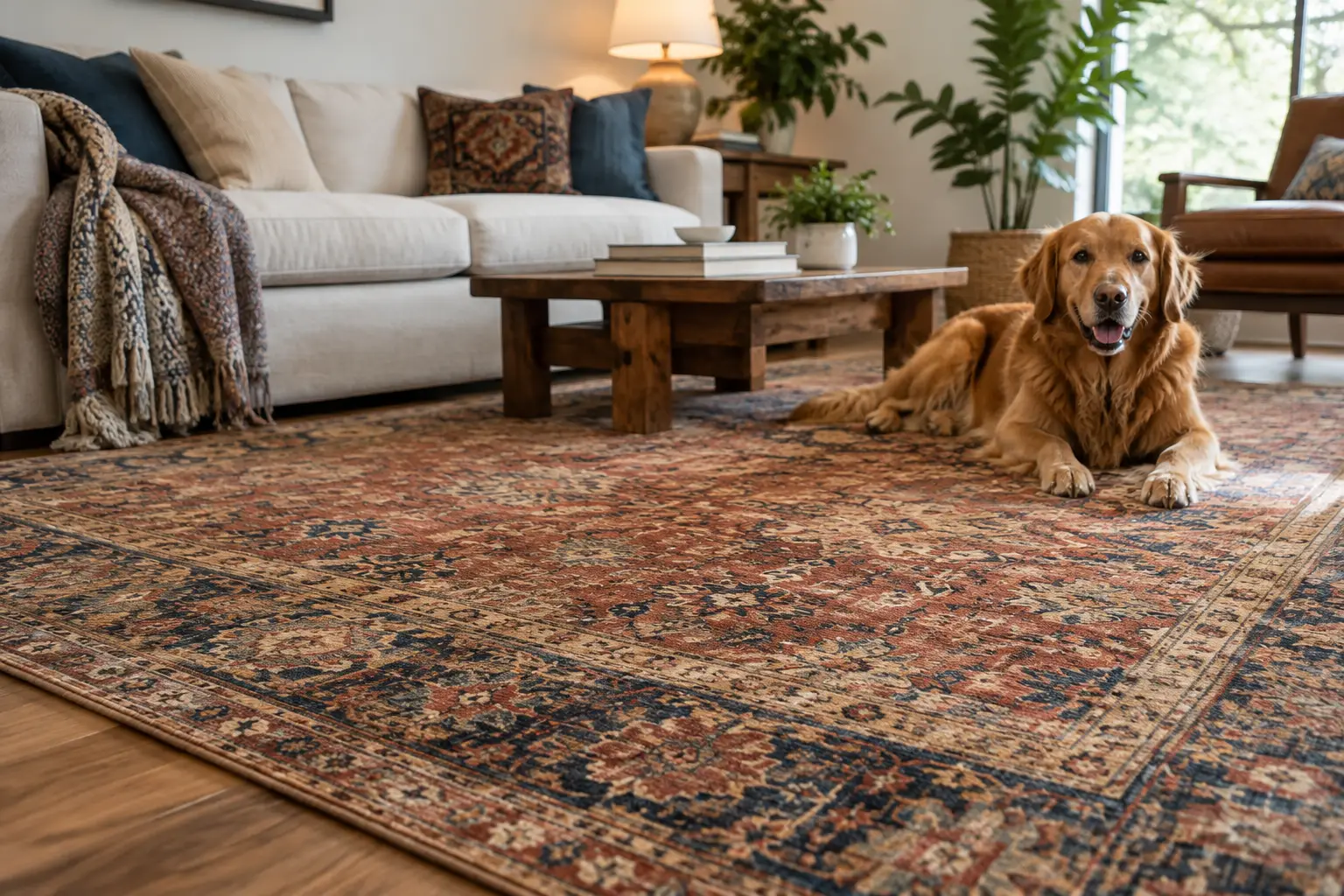
A fine antique rug can look disarmingly delicate: softened colors, a low, silken pile, perhaps a small area of visible wear that gives the piece its particular grace. Yet are antique rugs durable enough for real life? Often, remarkably so. A well-made wool rug that has already survived decades of use has demonstrated something a new rug cannot: the integrity of its materials, weaving, and color.
That does not mean every antique rug belongs beneath a kitchen table or in a front hall with a wet dog and three children. Age alone is not a measure of strength. The best choice depends on the rug’s construction, current condition, and the room it is meant to serve. When those elements are considered carefully, an antique rug can be one of the most enduring and forgiving layers in a home.
Why Antique Rugs Can Last for Generations
The durability of a good antique rug begins with its fiber. Traditional Persian, Turkish, Caucasian, and Central Asian rugs were commonly woven in wool, a material with a natural resilience that suits daily interiors beautifully. Wool fibers have a slight spring, so they recover well after furniture pressure and foot traffic. They also contain natural oils that help resist soil and make minor spills less alarming than they may seem.
Construction matters just as much. Handmade rugs are built knot by knot on a foundation of cotton, wool, or, in some tribal examples, goat hair. Their longevity is not simply a matter of knot count. Fine knots can create exquisite detail, but a more coarsely woven village or tribal rug may be exceptionally hard-wearing because of its dense wool, sturdy structure, and straightforward construction. A luminous Oushak with a spacious floral field, for example, can feel at home in a relaxed living room, while a finely drawn Persian rug may deserve a quieter setting where its detail can be appreciated.
The colors in older rugs are another practical advantage. Many antique pieces were dyed with natural materials or early high-quality dyes that have mellowed gradually over time. Instead of showing every speck of lint or a faint footprint, their layered abrash – the subtle variation in color that occurs from dye batch to dye batch – can make a room feel more relaxed. A rug with depth of color tends to live more easily than a flat, uniform surface.
Most importantly, antique rugs were not originally made as fragile wall hangings. They were made for floors, rooms, gatherings, and everyday domestic life. Their visual softness is often the result of use, not evidence that they cannot tolerate more of it.
Are Antique Rugs Durable in High-Traffic Rooms?
They can be, with a little judgment. A sound antique rug in good condition is often an excellent choice for a living room, dining room, bedroom, or library. These spaces benefit from the warmth and quiet character of an older textile, and the rug’s pattern can comfortably accommodate normal household activity.
For a high-traffic entry or a heavily used hallway, look for a piece with a denser weave, sturdy wool, and an allover pattern rather than a pale, open field. Antique Heriz rugs, many village Persian rugs, and some Turkish weavings are known for a more substantial character that can suit these locations well. A narrower antique runner can also be a practical way to bring history into a passageway, provided its ends and sides are secure.
The trade-off is pile. A rug with a full, even pile will generally have more life ahead of it than one worn close to the foundation. Low pile is not automatically a problem, particularly when it is even and stable, but it should influence where the rug goes. A softly worn antique Sultanabad may be ideal beneath a bed or in a low-to-medium traffic sitting room. A rug with exposed foundation, thinning areas, or fragile edges is better reserved for a bedroom, office, or another gentler space.
Dining rooms require their own consideration. Chairs sliding repeatedly across the surface can stress a very low-pile or delicate antique. A substantial rug pad helps, and felt pads beneath chair legs reduce friction. If the room sees frequent entertaining, choose a rug with enough visual movement to absorb the occasional spill and enough remaining pile to handle the chairs.
Condition Is More Important Than Age
An antique rug may be 80 or 120 years old and still be structurally sound. Another piece may be much younger but poorly repaired, weakened by moth damage, or worn beyond practical use. This is why thoughtful curation matters more than a label.
When evaluating an antique, begin with the foundation. A stable rug lies relatively flat, feels cohesive when handled, and does not have large areas where the warp and weft show through loosely. Look closely at the side bindings and ends. Minor wear, small old repairs, and softened fringe are normal in an antique textile. But unraveling sides, long splits, brittle areas, or extensive exposed foundation call for either restoration or a very specific, low-impact placement.
Repairs are not necessarily a reason to walk away. A skilled repair can extend a rug’s life and preserve a rare or especially beautiful weaving. The key is transparency and proportion. A few careful restorations in an otherwise strong antique are very different from broad areas of reconstruction. For collectors and designers alike, honest wear can be part of the appeal. It gives the surface a lived-in depth that cannot be manufactured convincingly.
It is also worth separating antique from vintage. In the rug world, “antique” commonly refers to a piece around 100 years old or more, while vintage rugs are generally younger. Both can be durable, but neither term guarantees condition. The individual rug always tells the more useful story.
The Details That Preserve an Antique Rug
A quality rug pad is one of the simplest ways to protect an antique rug. It prevents slipping, cushions the weave, reduces abrasion against the floor, and helps the rug retain a smoother appearance. Choose a pad appropriate to the floor finish, especially over hardwood, and avoid thick padding that makes furniture feel unstable.
Routine care should be gentle and consistent. Vacuum with the beater bar turned off, or use a suction-only setting, particularly on low-pile rugs and fringes. Vacuuming both sides occasionally removes embedded grit, which is more damaging than ordinary foot traffic. Do not pull a rug by its fringe, and do not vacuum fringe as if it were part of the field.
For a small spill, blot promptly with a clean, undyed cloth. Work from the edge inward and avoid saturating the rug or rubbing the fibers. Household spot treatments can create bigger problems than the spill itself, especially on older dyes or wool with a naturally aged surface. When a stain is significant, professional washing by a specialist who understands handmade rugs is the safer choice.
Rotate the rug once or twice a year if sunlight or traffic falls unevenly across it. This modest habit distributes wear and helps colors age more evenly. Direct, intense sun can fade any textile, so use window treatments or shift the rug seasonally in rooms with strong exposure.
Moths deserve attention, though not alarm. They are drawn to undisturbed natural fibers, particularly in dark, quiet areas beneath furniture. Regular vacuuming, occasional inspection, and a professional cleaning before long-term storage go a long way. Never store an antique rug in plastic for an extended period. It should be clean, dry, rolled rather than folded, and wrapped in a breathable material.
Choosing Durability Without Losing the Character
The most successful antique rug is not always the most pristine one. A perfectly preserved, high-pile piece may be better suited to a formal room, while a beautifully mellowed rug with stable, even wear can be exactly right for a family living space. The goal is to match the rug’s remaining life to the way the room is actually used.
Consider scale as part of practicality, too. A rug that is large enough to anchor furniture receives less stress at its edges than an undersized piece floating in the center of the room. In a living room, placing the front legs of seating on the rug creates a composed, grounded arrangement. In a dining room, allow enough room for chairs to remain on the rug when pulled back. These choices protect the textile while making the room feel more intentional.
For designers sourcing a one-of-a-kind piece, it is useful to share the project’s traffic level, pets, sunlight, and desired mood before selecting a rug. With more than 30 years in the handmade rug trade, Eskici Rugs approaches this as a conversation rather than a quick filter: the right piece should satisfy the palette and proportion of the room, but also the life that will unfold around it.
An antique rug does not need to be treated as precious to be treated well. Choose one with a sound structure, give it an appropriate setting and basic care, and let its softened color and history do what they do best: make a well-lived room feel more settled, personal, and complete.