
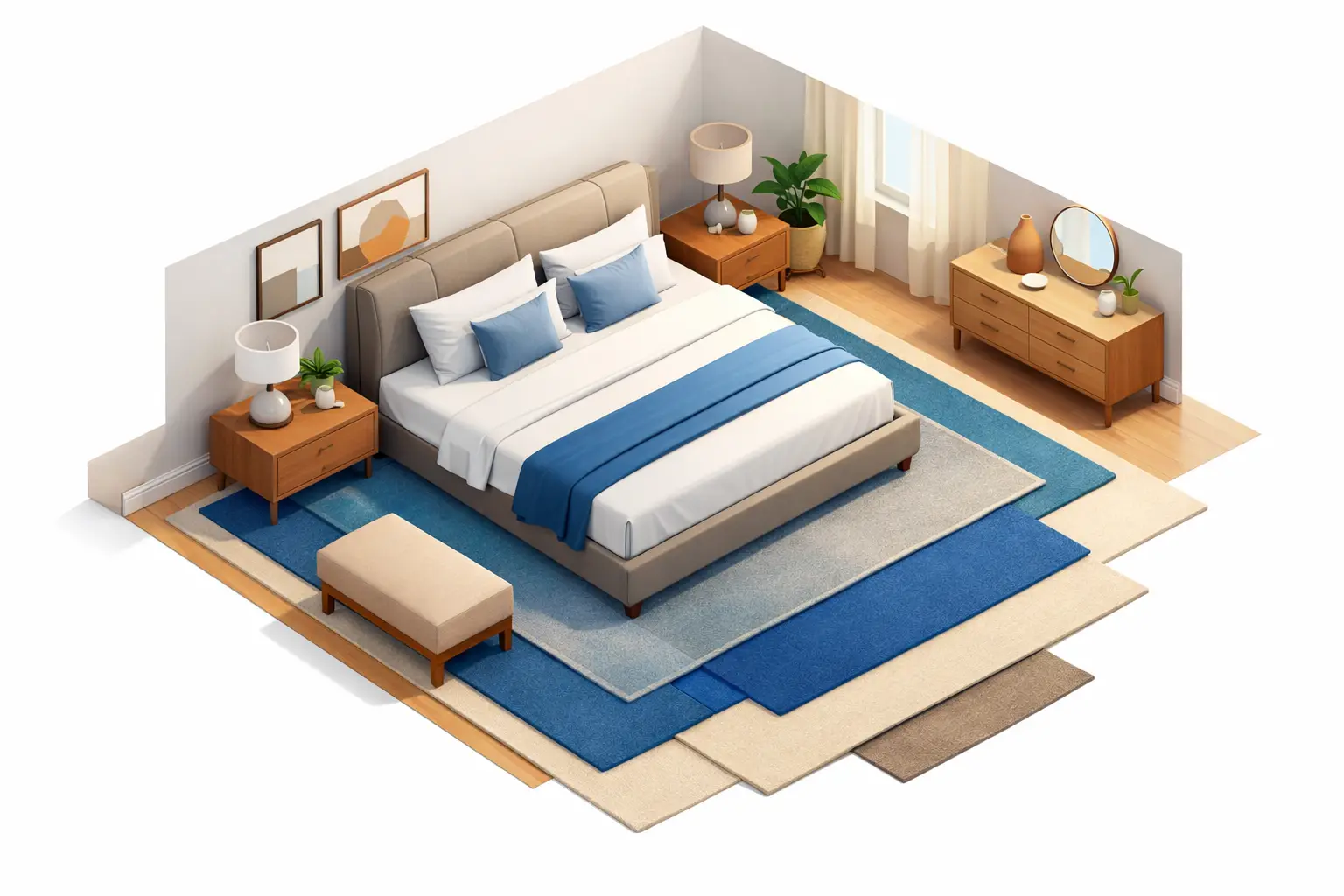
A king bed has an unusually strong visual footprint: at 76 inches wide and 80 inches long, it can make even a generous bedroom feel crowded when the rug beneath it is too small. If you are asking what size rug for king bed will look properly proportioned, begin with the floor you want to see around the bed, not just the dimensions of the mattress. The right piece creates a calm field of texture underfoot, frames the furniture, and gives the room the settled quality of a considered retreat.
For most bedrooms, an 8′ x 10′ rug is the most versatile starting point. A 9′ x 12′ rug is the more expansive, architectural choice for larger rooms or layouts with a bench and substantial nightstands. Runners offer a graceful alternative when a full rug would obscure a beautiful floor or exceed the room’s available footprint.
What size rug for a king bed works best?
The answer depends on the room, but there is a useful hierarchy. A rug should extend beyond both sides of the bed far enough to greet bare feet in the morning, ideally by 18 to 30 inches. It should also project beyond the foot of the bed, especially when there is a bench, chaise, or open passage at the end of the room.
| Rug size | Best for | What it achieves |
| 8′ x 10′ | Most standard king bedrooms | Covers the lower two-thirds of the bed and creates comfortable softness at each side |
| 9′ x 12′ | Large bedrooms and furniture-rich layouts | Grounds the bed, nightstands, and often a bench in one generous composition |
| 10′ x 14’ | Grand primary suites | Gives a king bed breathing room while preserving a wide border of rug around the entire arrangement |
| Two runners | Compact rooms or distinctive flooring | Adds comfort and color with a lighter, more tailored footprint |
These are guides rather than rules. Handmade vintage rugs do not always arrive in exact contemporary dimensions, and that variation is part of their character. An 8’2″ x 10’1″ piece may be every bit as successful as a precisely sized 8′ x 10′ rug when its proportion suits the room.
The 8′ x 10′ rug: the classic king-bed choice
An 8′ x 10′ rug is usually the most balanced answer for a king bed in a room around 12′ x 14′ or larger. Place it perpendicular to the bed, with the longer 10-foot side running parallel to the headboard. The rug should begin somewhere beneath the lower third of the bed, typically in front of the nightstands, then extend past the foot.
This arrangement leaves the nightstands on the hard floor while giving the bed a generous textile foundation. It is especially effective with antique Persian and Turkish rugs, whose detailed borders remain visible at the sides and foot rather than disappearing entirely beneath furniture. A composed border can act like a quiet frame around the bed, lending definition without making the bedroom feel over-designed.
There is one trade-off. If your bed includes an oversized upholstered frame, a deep footboard, or a bench, an 8′ x 10′ may feel short at the foot. In that case, either move up to a 9′ x 12′ or choose a layout that places the rug farther forward, prioritizing the walking area and bench rather than attempting to center every element precisely.
How far should an 8′ x 10′ rug sit under the bed?
A practical placement is to tuck 24 to 36 inches of rug beneath the bed from the foot side. This generally gives enough reveal on either side without pushing the rug too close to the wall. Before committing, mark the proposed dimensions with painter’s tape. It is a simple exercise, but it immediately reveals whether the rug will feel like an anchor or a small island beneath a large bed.
When a 9′ x 12′ rug is the better choice
A 9′ x 12′ rug brings a more generous, layered feeling to a primary bedroom. It is often the right scale when the room is at least 14′ x 16′, when nightstands are wide, or when the bed is styled with a bench at its foot. With this size, you can place the entire bed and both nightstands on the rug, or position the rug beneath the lower portion of the bed while allowing a broad margin around the sides.
The first approach feels cohesive and formal. It works beautifully in rooms with substantial wood furniture, tall ceilings, and enough open floor around the perimeter. The second is slightly lighter and can be preferable when you want a vintage rug’s field and border to remain visible, particularly with a one-of-a-kind Oushak or Sultanabad whose open color and softened pattern deserve to be seen.
Do not choose a 9′ x 12′ simply because the room is large. A rug should still leave a visible band of flooring around its edges, generally 12 to 24 inches from the walls. If it nearly touches three walls, it can read as wall-to-wall carpeting rather than a deliberate furnishing. In an irregular room, preserving a clear path around the bed matters more than following a standard formula.
A note on benches, nightstands, and seating
Bedroom rugs succeed when they account for the whole furniture plan. A bench at the foot of a king bed changes the calculation more than most people expect. Ideally, the bench sits fully on the rug, with several inches of textile extending beyond it. If that would make an 8′ x 10′ feel compressed, a 9′ x 12′ gives the arrangement the breathing room it needs.
Nightstands present a stylistic choice. Leaving them off the rug is entirely appropriate in a standard bedroom and often allows a smaller room to feel more open. Placing them on the rug creates a more enveloping composition, but it demands a larger size. Avoid the in-between arrangement where only the front legs of bulky nightstands rest on the rug. It can look accidental and may make drawers or doors less stable.
If a sitting area occupies the bedroom, treat it as its own zone unless the room is especially large. One oversized rug can unify a suite, but two carefully related rugs often create more depth: a character-rich vintage piece under the bed and a smaller complementary textile beneath a pair of chairs, for example.
Runner layouts for smaller rooms
Two runners placed along each side of the bed are an elegant solution for narrow bedrooms, rooms with radiant-heated floors you prefer to reveal, or spaces with beautifully finished hardwood. Choose runners that are long enough to extend from roughly the nightstand area toward the foot of the bed. In most king-bed rooms, 2’6″ x 8′ or 3′ x 9′ runners provide a pleasing length.
Runners should feel intentional, not like narrow strips pushed against the bedside. Leave a small margin between each runner and the bed frame, and align the pair with the room’s architecture where possible. This approach is also an opportunity to introduce pieces with more intricate drawing or deeper color. Because less of the textile is covered, a finely woven antique fragment or a pair of luminous vintage runners can become a meaningful part of the room’s visual story.
A single runner at the foot of the bed can work, but it offers less everyday comfort and is best reserved for a room where side clearance is limited. It is a finishing gesture rather than a full foundation.
Let the rug’s character guide the placement
Size establishes proportion, but the rug’s design determines how it will live beneath the bed. Large-scale, softly drawn motifs are especially forgiving under furniture because they retain their presence even when partially covered. This is one reason Turkish Oushaks and open-field Turkish rugs work so naturally in bedrooms: their color, movement, and gentle irregularity create warmth without visual noise.
More detailed antique Persian rugs can be equally compelling, though it is worth considering where a central medallion will fall. If the medallion disappears completely under the bed, the rug may still be beautiful, but its composition can feel less legible. In that situation, a lower placement that reveals the center and foot-end border may be preferable to a fully centered arrangement.
Color also affects perceived scale. A pale rug with a quiet, open ground can make a king bed feel lighter and the room more expansive. A richly saturated textile gives the bed presence and intimacy, especially in a large room that otherwise feels spare. Neither is inherently better. The choice is about the atmosphere you want to wake up in.
Measure before you fall for a one-of-a-kind piece
Measure the room, bed frame, nightstands, and any bench before shopping, then tape out both an 8′ x 10′ and 9′ x 12′ option. Walk around each outline with drawers open and doors in motion. Notice the path from the bed to the closet and bath. The most beautiful rug is only truly successful when it supports the room’s daily rhythm.
For a king bed, favor a rug that feels slightly more generous than slightly too small. A well-chosen handmade rug does more than soften the floor: it brings age, texture, and quiet character to the place where the day begins and ends. Let the dimensions establish the structure, then choose the piece that makes the room feel distinctly your own.