
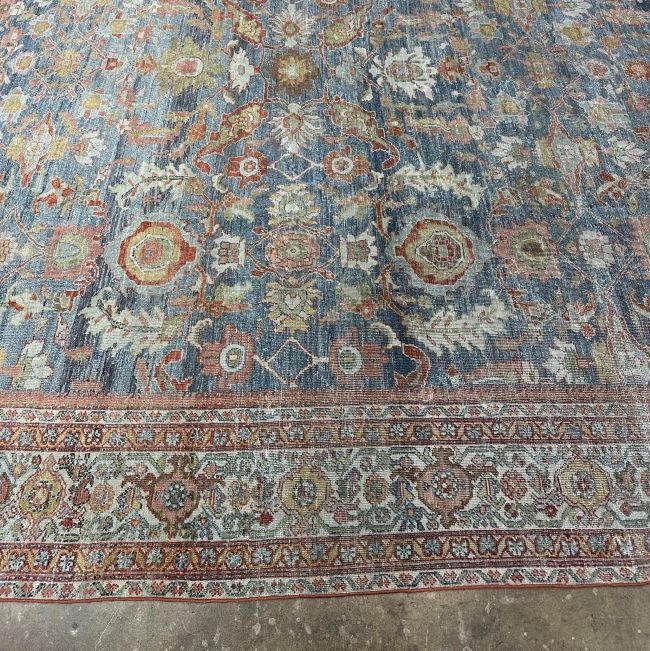
A Sultanabad rug tends to read clearly across a room before you notice any single motif. That is part of its appeal, and one of the defining Sultanabad rug characteristics collectors and designers return to again and again. These rugs have presence without feeling busy, softness without losing structure, and a kind of composure that makes them unusually easy to live with.
For anyone furnishing a layered interior, that balance matters. Sultanabad rugs are rooted in Persian weaving, yet they often feel remarkably current in American homes because their patterns are spacious, their colors tend to be warm and usable, and their overall effect is generous rather than rigid. They do not ask a room to revolve around them, but they do anchor it.
What defines Sultanabad rug characteristics?
Sultanabad refers to rugs woven in and around the Arak region of western Persia during the late 19th and early 20th centuries, especially pieces created for a growing export market. That history helps explain why the style feels both Persian and broadly adaptable. These rugs retained the technical language of Persian weaving while embracing a looser scale and a more open visual field that suited larger Western interiors.
The most recognizable Sultanabad rug characteristics are large-scale drawing, spacious floral motifs, softer geometry, and an ease in composition that feels less intricate than many transitional Persian rugs. You will often see palmettes, vine networks, rosettes, and botanical forms arranged with room to breathe. Even when the pattern is complex, it rarely feels crowded.
Color is another essential part of the story. Sultanabad rugs are often associated with terracotta, brick red, rose, muted blue, ivory, soft gold, tobacco, and weathered brown. In older examples, these hues usually mellow beautifully over time. The result is depth rather than brightness – color that sits comfortably within a room instead of shouting for attention.
Scale is part of the magic
One reason designers continue to favor Sultanabad rugs is scale. The motifs are often enlarged in a way that reads well from a distance, which makes these rugs especially effective in living rooms, dining rooms, and larger bedrooms. A fine, highly intricate rug can be extraordinary, but it may require close viewing to fully register. A Sultanabad often gives back immediately.
That does not make it simpler in any lesser sense. Rather, the scale creates visual calm. In a room with upholstery, wood tones, lighting, art, and textiles all competing for attention, a rug with broader pattern spacing can make the entire composition feel more settled.
This is also why Sultanabad rugs work so well in beautifully layered interiors. They support a room’s architecture and furnishings instead of fragmenting the floor into too many small visual moments. If you are looking for a rug that adds character while keeping the space coherent, this is often the right direction.
Open pattern, softer form
Many Persian rugs are celebrated for precision and density. Sultanabad rugs offer a different kind of refinement. Their motifs often feel slightly more relaxed, with curves and floral forms that are expressive rather than strict. Borders can be substantial without becoming heavy, and the field pattern often has a gentle rhythm that feels inviting.
That softness matters in design terms. In rooms with clean-lined furniture, plaster walls, stone fireplaces, or oak floors, Sultanabad rugs can introduce movement and age without visual hardness. In more traditional spaces, they reinforce warmth while avoiding fussiness.
Color and patina in Sultanabad rugs
When people respond emotionally to a vintage Sultanabad, color is usually a major reason. These rugs are known for nuanced palettes that carry warmth and complexity. Reds may lean dusty rather than sharp. Blues often appear softened by age. Ivory, camel, sand, and muted gold create lift and contrast without making the rug feel stark.
Patina is equally important. In antique and vintage examples, wear can soften the palette and blur transitions in a way that gives the rug its quiet character. This is not a flaw to be corrected away. In the right piece, abrash, age, and gentle variation are part of what makes the rug feel alive.
That said, not every buyer wants the same degree of age. Some prefer lower pile and visible wear for a more collected look. Others want stronger pattern definition and a bit more body underfoot. With Sultanabad rugs, both can be valid choices. It depends on whether your priority is atmosphere, durability, or a balance of the two.
Construction and feel underfoot
Traditional Sultanabad rugs are hand-knotted wool rugs, typically with a cotton foundation in many examples, though materials can vary by age and workshop. Compared with some tightly woven Persian city rugs, many Sultanabad rugs have a somewhat coarser weave and a thicker, more substantial handle. That construction contributes to their relaxed drawing and broad motifs.
Underfoot, they often feel grounded and natural rather than overly polished. In vintage pieces, the pile may range from medium to low depending on age and wear. A lower pile can be especially appealing in active rooms because chairs move more easily and the rug settles into the architecture of the space. A fuller pile, on the other hand, may offer a richer surface and stronger color presence.
No single construction detail should be judged in isolation. A rug with some age-related wear may still be the better choice if its color, scale, and overall composition are exceptional. Likewise, a technically cleaner piece is not always the most compelling one in a finished room.
How Sultanabad rug characteristics translate in interiors
Sultanabad rugs are unusually versatile because they bridge decorative warmth and structural clarity. In living rooms, they pair well with linen upholstery, mohair, leather, walnut, oak, plaster, and antique brass. They also handle contrast well. A more traditional Sultanabad can sit comfortably beneath contemporary furniture because the pattern is expansive rather than fussy.
In dining rooms, the style’s broad patterning helps the rug remain legible under a table and chairs. In bedrooms, the softened palette can make the room feel settled from the moment you enter. Hallways and studies can also benefit, though very valuable antique examples may be better reserved for lower-friction spaces depending on condition.
When a Sultanabad is the right choice
If you want a rug with gravitas but not formality, Sultanabad is often a strong fit. It suits rooms that need warmth, larger spaces that can handle generous pattern scale, and interiors where materials already carry texture and age. It is especially effective when you want the floor to feel designed but not overly decorated.
If your room is very small, highly graphic, or built around crisp modern contrasts, another style may make more sense. A Sultanabad can still work in a contemporary setting, but the success usually comes from balance. The rug should soften the room, not fight with it.
What to look for when buying
A good Sultanabad should feel composed from a distance and rewarding up close. Start with the field and border relationship. Neither should dominate to the point that the rug feels top-heavy or restless. Look at how the motifs scale to the rug’s size, and whether the palette has enough variation to feel dimensional.
Then consider condition in practical terms. Even wear can be beautiful. Structural issues, weak areas, or repairs may or may not be acceptable depending on placement. A bedroom can tolerate more delicacy than a busy family room. Trade professionals often weigh this instinctively, but homeowners benefit from asking the same question: will this piece age gracefully where it is going?
It is also worth paying attention to mood. Some Sultanabad rugs feel earthy and architectural. Others are floral, airy, or more romantic. Neither is better. The right choice is the one that supports the room you are building.
At Eskici Rugs, this is where curation matters most. In a market crowded with broad labels and uneven sourcing, the difference is often not whether a rug is called Sultanabad, but whether it has the color balance, scale, authenticity, and character that make the style so enduring.
The most memorable rugs do more than match a palette. They steady a room, give it history, and make everything around them look a little more considered. Sultanabad rugs do that with unusual ease, which is why they remain one of the most trusted choices for interiors meant to last.