
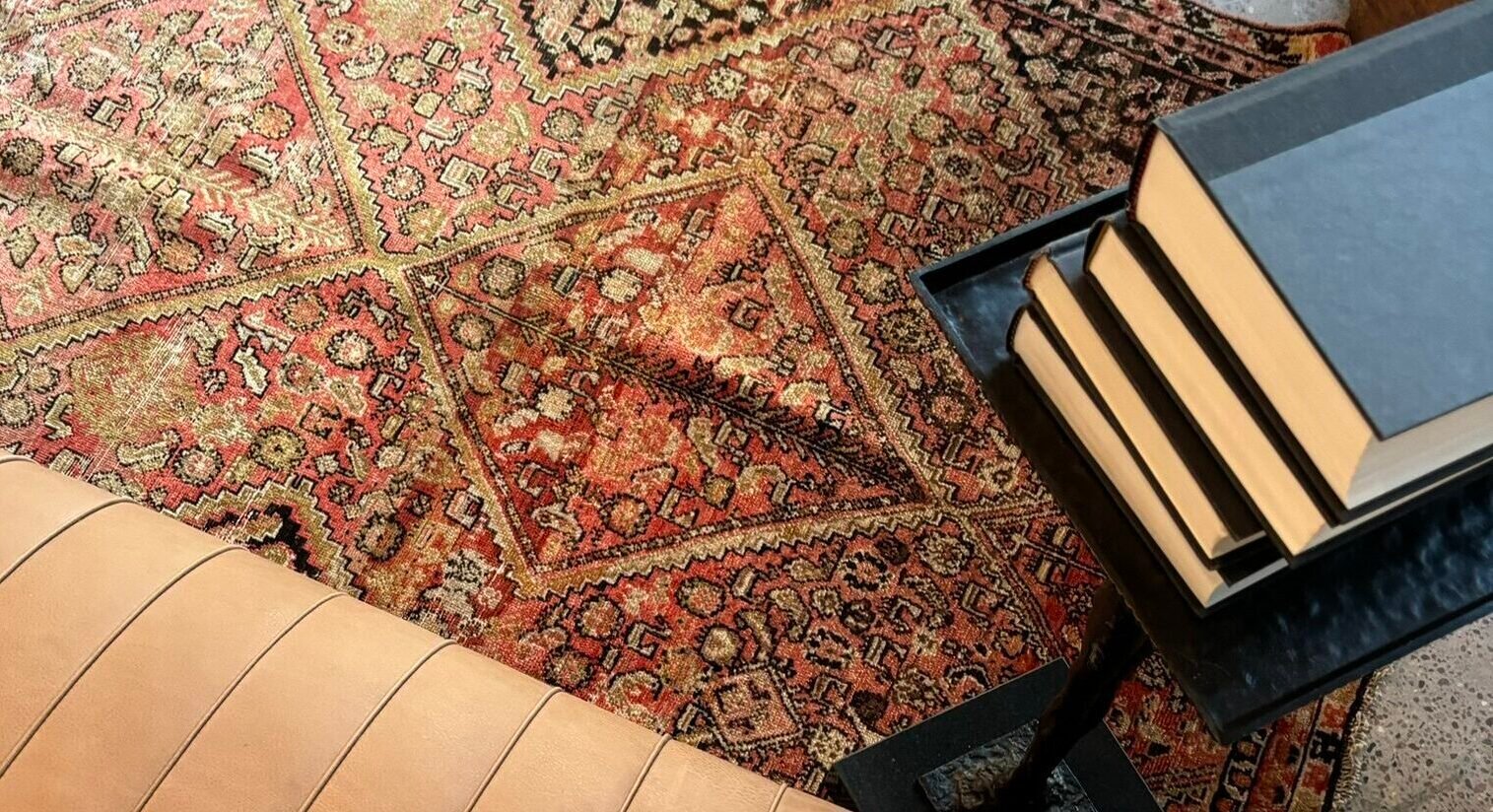
A rug is often understood as a finishing layer—something that completes a room, softens it, brings it together. It is chosen for color, for texture, for proportion.
But this reading is incomplete.
A rug is not simply placed in a space—it carries one with it.
What lies beneath furniture and underfoot is, in many cases, the result of a much longer process: one shaped by geography, by tradition, and by the quiet decisions of the individual who made it. To understand a rug only in relation to the room it occupies is to overlook the depth it already contains.
It is, more precisely, a cultural artifact.
Place: The Origin of Material and Language
Every rug begins with place.
Before a pattern is drawn or a loom is set, the conditions of a region have already determined much of what will follow. The type of wool available, the plants that can be used for dye, the climate that influences durability and texture—these are not aesthetic choices, but realities.
Over time, these constraints become a language.
Certain palettes recur not because they are stylistically preferred, but because they emerge naturally from the landscape. Earth tones, softened reds, muted blues—these are often direct translations of the environment. In the same way, patterns develop as part of a shared visual vocabulary, repeated and adapted across generations.
But place is not only material—it is also cultural.
Rugs carry systems of meaning that are specific to the communities that produce them. In tribal weavings, motifs often function as symbols—references to protection, fertility, identity, or belonging. They are not simply decorative elements, but part of a visual language understood within a particular cultural context.
In contrast, the intricate floral compositions of Persian rugs reflect a different expression of place—one shaped by courtly traditions, artistic refinement, and a long history of ornamentation. Here, the emphasis shifts from symbolism to composition, balance, and detail, yet it remains equally rooted in a cultural vision.
These differences are not incidental. They reflect how a culture, within a specific place, chooses to represent the world—what it values, what it preserves, and how it translates those ideas into form.
Place, then, does not dictate a single outcome. It defines both the material conditions and the cultural framework within which a rug is made.
Time: Continuity and Expression
If place establishes the conditions, time gives them continuity—but also form.
Rug making is, at its core, a practice of transmission. Techniques are passed down, refined, and preserved. Motifs are repeated—not as static forms, but as evolving ones. Even when a rug appears timeless, it is always anchored in a specific moment.
But time does more than carry tradition forward. It also shapes how that tradition is expressed.
Every period brings with it a particular sensibility—a way of seeing proportion, color, and composition. Some rugs reflect moments of richness and complexity, where pattern becomes dense and intricate. Others belong to periods of restraint, where space opens up and palettes soften.
These shifts are often subtle, but they are perceptible. A rug woven decades ago does not interpret a motif in quite the same way as one woven today. The structure may remain, but the expression changes.
In this sense, rugs are not only vessels of continuity—they are records of aesthetic moments.
A vintage piece carries not just the techniques of the past, but the way those techniques were understood and expressed at a specific point in time. Its wear is not simply a sign of age, but of having moved through different spaces, different interiors, different contexts.
A rug, then, is never entirely new. Nor is it entirely fixed in the past. It exists within a continuum—shaped by what came before, and marked by the moment in which it was made.
The Individual: The Medium of Expression
And yet, no rug is purely the product of place and time.
There is always a third element: the individual.
The weaver does not simply execute a tradition. They carry it—absorbing the materials, the motifs, and the visual language of a place, along with the sensibility of a given moment in time. But what emerges is never a direct translation.
It is an interpretation.
Each decision—conscious or not—passes through the hand of the weaver. The tension of a knot, the spacing of a motif, the balance between colors—these are not fixed outcomes, but resolved in the moment of making.
In this sense, the individual is not separate from place and time, but the medium through which both are expressed.
Two weavers, working within the same tradition, in the same region, at the same time, will never produce the same rug. Not because they are trying to be different, but because interpretation is inevitable.
What may appear as irregularity is, in fact, authorship.
Tradition provides the framework. Place defines the language. Time shapes its expression. But it is the individual who brings all of these elements into form.
This is what makes every rug singular.
A Different Approach to Choosing
To choose a rug, then, is not only to select something that fits.
It is to decide what kind of presence you want a space to hold.
Whether consciously or not, the pieces we bring into an interior carry meaning. Some are neutral, interchangeable, easily replaced. Others resist that—they hold a sense of specificity, of having come from somewhere, of having been made by someone.
Rugs belong to this second category.
And perhaps this is why the process of choosing one can feel complex. It is not simply about finding the right size or color. It is about recognizing when something feels resolved—when the dialogue between the space and the object is complete.
That moment rarely comes from abundance of choice.
It comes from clarity.
Finally
Tradition provides the framework. Place defines the language. Time shapes its expression. But it is the individual who brings all of these elements into form.
This is what makes every rug singular.
A rug is the result of a dialogue between place—both physical and cultural—time, and the individual. It carries the language of a place, the continuity and aesthetic expression of a moment in time, and is ultimately shaped through the interpretation of the weaver—the medium through which all of these elements are brought into form.