
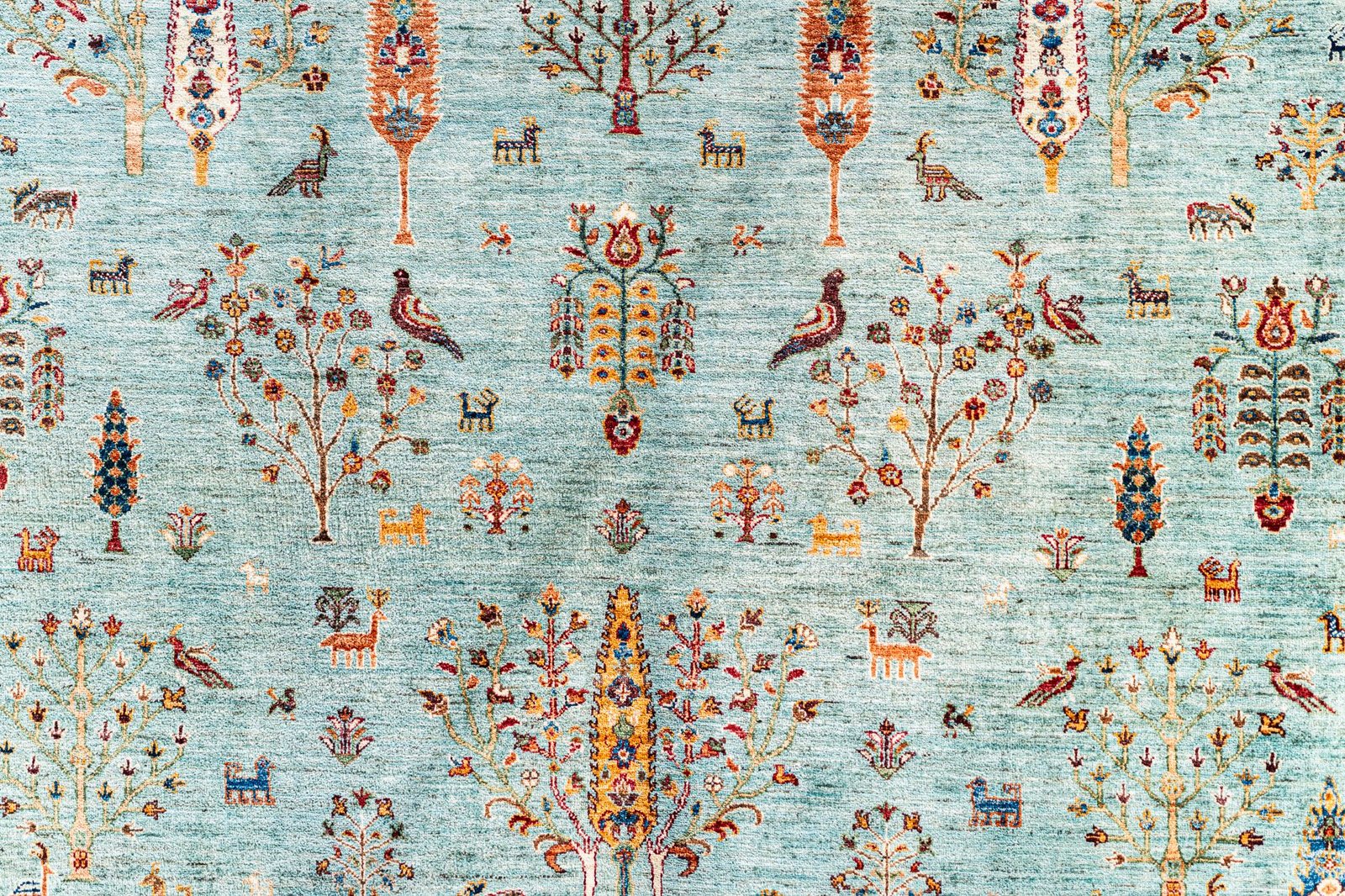
A Persian rug rarely feels anonymous. Even before you know its age, region, or weave, it often carries a sense of intention – a garden laid out in pattern, a protective border, a flowering branch, a medallion that steadies the entire field. That is part of the lasting appeal behind persian rug symbolism meaning: these rugs were not designed as surface alone, but as woven expressions of memory, belief, landscape, and daily life.
For design-minded homeowners and interiors professionals, symbolism adds a deeper layer to the buying process. It helps explain why one rug feels lyrical and open while another feels architectural and grounded. It also reminds us that handmade rugs can hold more than color and texture. They carry visual languages that developed over generations, often with regional variations, workshop traditions, and personal interpretation woven into the same piece.
What persian rug symbolism meaning really refers to
When people ask about persian rug symbolism meaning, they are usually looking for a translation key – a simple answer for what each motif stands for. Some symbols do have commonly accepted associations, but Persian rugs are rarely that fixed. Meaning shifts according to region, era, tribe, workshop practice, and even the weaver’s own instincts.
That nuance matters. A boteh may be read as a seed, a cypress, a flame, or a sign of growth and vitality. A floral vine can suggest paradise, continuity, or the cultivated beauty of a garden. A medallion may echo celestial order, architectural planning, or simply an aesthetic convention perfected over centuries. The richness lies in the overlap.
In other words, symbolism in Persian rugs is less like a dictionary and more like a visual tradition. Certain motifs return again and again because they carry enduring ideas – protection, abundance, life, eternity, harmony – but they are interpreted through design as much as through literal meaning.
The motifs most often tied to Persian rug symbolism meaning
Some of the most recognizable Persian motifs are also the most symbolically layered. The boteh, often described as a curved teardrop or paisley-like form, is among the best known. In many readings, it suggests growth, fertility, or the energy of life. Its shape can feel both botanical and flame-like, which may explain why it has remained so compelling across centuries.
The tree of life is another powerful image. In rugs, it can appear as a singular rising form or as a branching structure integrated into a larger field of flowers and vines. It is often associated with life, connection between earthly and spiritual realms, and renewal. In an interior, that symbolism can make a tree-based design feel especially grounding without becoming heavy.
Floral motifs are equally central. Rosettes, palmettes, lotus forms, and scrolling vines are not merely decorative fillers. In Persian design language, flowers often point to ideas of beauty, paradise, and cultivated abundance. Many floral rugs draw from the imagery of Persian gardens, which were themselves deeply symbolic spaces – ordered, life-giving, enclosed, and restorative.
Animal figures introduce another register. Birds may suggest freedom, the soul, or joyful presence. Fish motifs can relate to abundance and movement. Lions have historically signaled strength and authority. Deer and gazelles may evoke grace, nature, and serenity. Yet here again, context matters. In some rugs, animal imagery is bold and narrative. In others, it is subtle enough to be missed at first glance.
Geometric forms also carry meaning, though often in a quieter way. Diamonds, lozenges, stars, and repeating angular forms can imply protection, continuity, and order. Tribal and village weavings tend to express these ideas more abstractly than city workshop rugs, which often favor curvilinear floral refinement. Neither is more meaningful than the other. They simply speak in different visual dialects.
Borders, medallions, and layout are part of the story
It is tempting to focus only on individual motifs, but a rug’s composition also contributes to its symbolism. Borders are especially important. In practical design terms, they frame the field and create balance. Symbolically, they can function as thresholds or protective enclosures, holding the inner world of the rug together.
The central medallion often acts as an anchor. Depending on the rug, it may recall a dome, a garden plan, or a centered universe. In a room, medallion rugs tend to create a strong visual core, which is one reason they work so well in formal seating arrangements, dining rooms, and spaces that benefit from structure.
Allover designs tell a different story. Without a single dominant center, they feel expansive and continuous. That sense of repetition can suggest infinity, flow, and a more atmospheric kind of order. For layered interiors, this is often where symbolism and styling meet beautifully – the pattern reads as generous rather than rigid.
Color symbolism in Persian rugs
Color is never incidental in handmade rugs, and in Persian traditions it often carries emotional and symbolic weight. Red is one of the most common field colors, frequently associated with vitality, warmth, courage, and celebration. It can make a rug feel deeply alive, especially when softened by age into brick, rose, or terracotta tones.
Blue often suggests calm, spirituality, and protection. Navy grounds a room with elegance, while lighter blues can bring a more open, airy quality. Green has historically been used more sparingly in some Persian weavings and can evoke renewal, nature, and sacred associations. Ivory and undyed wool introduce light, clarity, and contrast.
Gold, saffron, and earthy browns tend to feel linked to richness, harvest, and the natural world. Of course, dyes also depended on local materials and workshop preferences, so not every color choice was purely symbolic. Sometimes the beauty of a rug comes from that overlap between meaning and material reality.
Region shapes meaning as much as motif
Persian rug symbolism is not uniform across all weaving centers. A city rug with finely drawn floral arabesques may communicate very differently from a village rug with bolder geometry. Isfahan, Kashan, Tabriz, Heriz, Hamadan, and other weaving regions developed distinct visual languages, and those differences affect how symbolism is expressed.
A Heriz, for example, often feels architectural and forceful, with angular medallions and strong geometry. A Kashan may read as more garden-like and refined, with curving floral detail and a formal sense of symmetry. Tribal and village rugs may carry symbols more directly, sometimes with a spontaneity that feels personal rather than polished.
This is one reason symbolic interpretation should stay flexible. The same motif can move from poetic to graphic, from ceremonial to domestic, depending on where and how it was woven. For collectors and designers, that is part of the pleasure. Meaning is present, but it is never flat.
How symbolism can guide a design decision
You do not need to decode every motif to choose well. Still, understanding symbolism can sharpen your eye. If you are furnishing a room that needs calm structure, a medallion rug with ordered floral elements may feel right. If you want warmth and a sense of lived history, a piece with boteh forms, softened reds, and a more relaxed field can bring that quiet character naturally.
For designers, symbolism also helps with storytelling. A rug with garden references can support an interior that leans organic and layered. A geometric village weaving can add conviction to a room that needs contrast, tension, and grounded form. The point is not to force a narrative onto a piece, but to recognize when a rug’s visual language aligns with the emotional atmosphere of a space.
There is also a useful caution here. Symbolism should enrich a selection, not overrule the fundamentals. Scale, palette, condition, material, and the way a rug sits within the architecture still matter just as much. A beautiful symbolic motif will not rescue the wrong size for a room.
Why these meanings still resonate now
Part of the continued relevance of Persian rugs is that their symbolism does not feel purely historical. Ideas like protection, abundance, harmony, and renewal remain deeply human. They translate across eras because they are tied to home, memory, beauty, and the desire to make a lived space feel meaningful.
That is especially true in interiors that resist disposability. A handmade rug with cultural depth tends to age well not only because of its materials, but because its design holds more than trend. It offers pattern with inheritance behind it.
At Eskici Rugs, that is often what distinguishes a memorable piece from a merely decorative one. The best rugs do not just fill a floor. They bring presence, texture, and a sense that the room has been considered with care.
If you are drawn to Persian rugs, symbolism can be a helpful lens, but not the only one. Let it deepen your understanding without making the process overly literal. Often the right rug is the one that speaks before you can fully explain why – and later, the meanings simply give that instinct a beautiful name.