
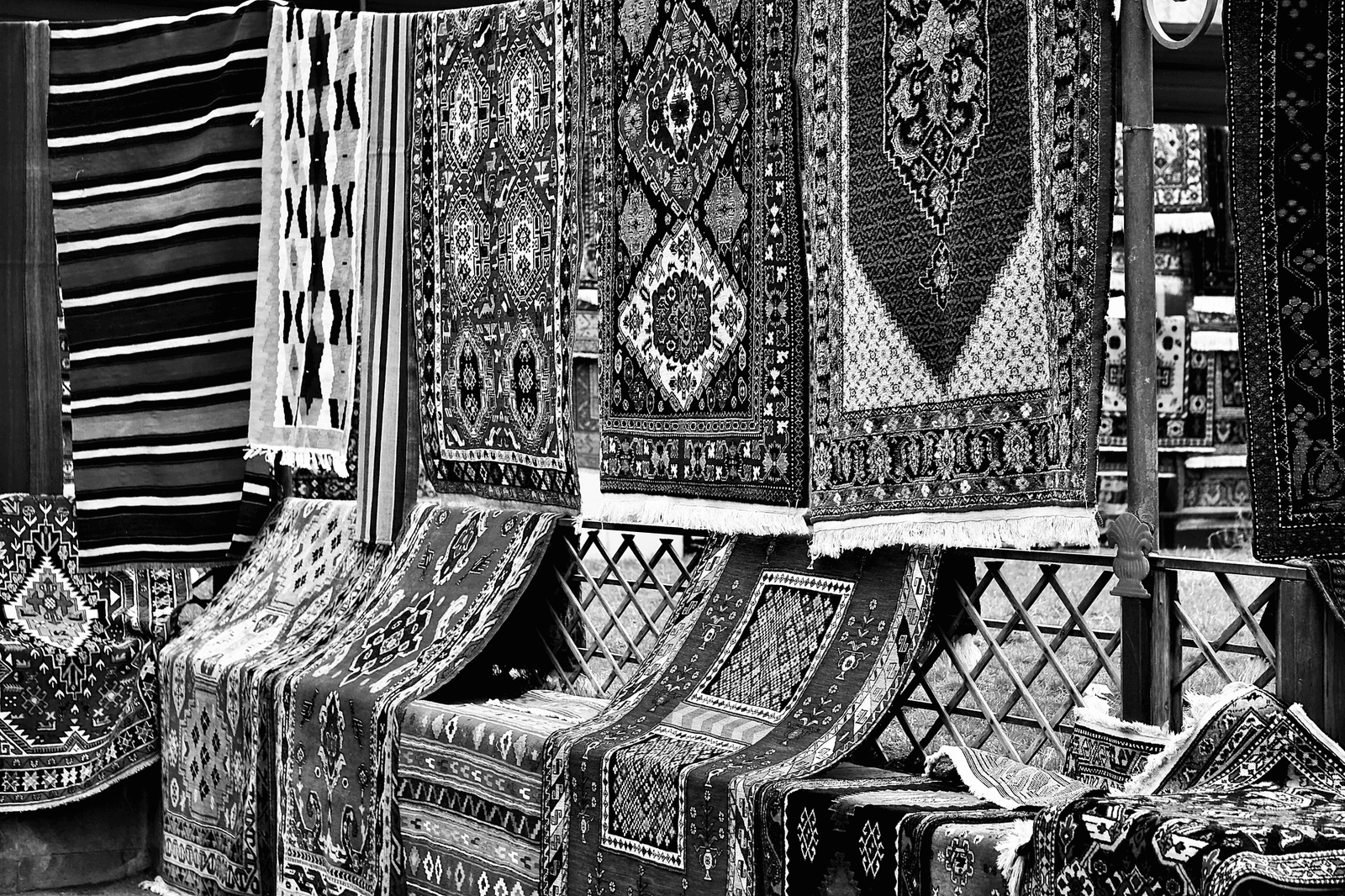
An antique rug can make a newly finished room feel collected rather than decorated. Its softened palette, irregular detail, and handwoven texture bring a sense of time that cannot be replicated by a newly made piece. But knowing how to buy antique rugs requires more than falling for a beautiful photograph. Age, construction, condition, scale, and provenance all shape both the character of the rug and its place in your home.
The right piece does not need to be pristine or overly precious. It should feel right underfoot, proportionate to the room, and visually at ease with the life being lived around it. A well-chosen antique rug is decorative, certainly, but it is also a textile with a history of making behind it.
Start With the Room, Not the Rug
Before considering origin or age, establish the rug’s role in the room. Antique rugs often have a stronger point of view than contemporary floor coverings: a Persian Heriz may lend graphic structure to a living room, while an Oushak can soften a bedroom with an open field and gentle color. Let the room tell you whether it needs an anchor, a quiet layer, or a focal point.
Measure the furniture arrangement, not just the open floor. In a living room, a rug should usually hold at least the front legs of the seating group. In a dining room, allow enough room for chairs to remain on the rug when pulled back. Bedrooms can accommodate a large rug beneath the bed or smaller runners placed along each side.
Antique rugs were often woven in nonstandard dimensions, which is part of their appeal. A size that is a few inches shy of the conventional ideal may still look more intentional than a perfectly measured rug with no presence. The key is to make that decision consciously, especially in rooms with strong architectural lines.
Understand What “Antique” Means
In the rug trade, an antique rug is generally understood to be around 80 years old or older. Pieces made roughly 50 to 80 years ago are often described as semi-antique or vintage. The terminology can vary, so ask for the estimated age rather than relying on a label alone.
Age is not automatically a measure of quality. A finely woven rug from the early 20th century may be more valuable than a coarser, older example, while a beautiful mid-century Turkish rug may be the better choice for a relaxed, layered interior. What matters is the relationship between age, craftsmanship, condition, and design.
Regional vocabulary gives useful context. Persian rugs encompass a wide range of weaving traditions, from the richly patterned workshop rugs of Tabriz and Kashan to the more geometric village weavings of Heriz. Turkish Oushaks are admired for their broad-scale motifs and quietly faded palettes. Sultanabads often offer generous scale and graceful botanical pattern, making them especially suited to larger rooms. Knowing these distinctions helps you recognize what you are drawn to, but it should not become a rigid rulebook.
How to Buy Antique Rugs With an Eye for Craftsmanship
Turn the rug over when possible. The reverse reveals the construction more clearly than the pile side. Hand-knotted rugs show individual knots and a pattern that is visible, though less vivid, from the back. Handwoven flatweaves have no pile and are generally reversible. Machine-made rugs tend to have a uniform backing, artificial-looking fringe, or a construction that does not reveal individual hand-tied knots.
Materials matter as much as technique. Wool is the classic foundation of many antique rugs because it is resilient, warm, and naturally receptive to dye. It develops a pleasing patina as it ages. Cotton is commonly used in foundations, while silk may appear in finer rugs intended for lower-traffic settings. A silk rug can be extraordinary, but it deserves more careful placement than a sturdy wool village weaving.
Look closely at the wool. Good old wool often has depth rather than shine, with small variations in tone that create movement across the surface. Natural dyes can produce this same sense of nuance, shifting gently from one area to another. These tonal changes, sometimes called abrash, are not flaws. They are evidence of hand-dyed yarn and a lived-in making process.
Read Condition Honestly
Condition deserves a clear-eyed assessment, particularly if the rug will be used in an active household. Antique rugs may show areas of lower pile, small repairs, edge wear, or slight variations in color. These qualities can be entirely appropriate, even desirable, when they are stable and proportionate to the overall piece.
Ask whether repairs have been professionally executed and whether the foundation is sound. Look for exposed warps, brittle areas, loose edges, severe moth damage, or stains that may not respond to cleaning. A rug with gentle wear can bring warmth to a room. A rug with structural weakness may require restoration before it can be used confidently.
There is also a practical question of placement. A finer antique Persian rug may be ideal for a formal sitting room or primary bedroom, while an antique Oushak or a durable Turkish runner can be more forgiving in a hallway. If children, pets, or frequent entertaining are part of the picture, choose a rug whose level of wear will look natural as it continues to live with you.
Choose Color for the Light You Actually Have
Antique rugs are often purchased for their palette, but color should be judged in the context of your own interior. A rug that reads soft rose in a bright studio may feel warmer, deeper, or more muted in a north-facing living room. Ask for images in natural light and, when available, a close view of the field, border, and areas of wear.
Do not assume an antique rug must match the room exactly. The most convincing interiors often rely on a conversation between colors rather than a perfect match. A faded rust can enrich cool gray upholstery. Mossy green can give definition to creamy walls. A rug with touches of indigo may connect a room without requiring blue to appear everywhere else.
Pattern scale is equally influential. Large, open motifs tend to read calmly in a room and work well beneath furniture. Dense allover designs can create intimacy and detail, especially in studies, dining rooms, and entryways. If the room already includes patterned drapery or expressive wallpaper, a rug with a quieter field may provide the needed visual rest.
Buy Online With Better Questions
A curated online source can make the search more focused, but photographs should be supported by useful information. Confirm the exact dimensions, including fringe if relevant, and ask whether the colors have been adjusted in photography. Request images of the back, corners, edges, and any repaired areas if they are not already shown.
It is also wise to understand the return policy, shipping process, and how the rug will be packaged. A rug is a substantial purchase, and confidence comes from clarity before it arrives. At Eskici Rugs, careful curation is intended to narrow an enormous field of options into pieces chosen for their material presence, proportion, and quiet character.
Price should be considered in context. Origin, age, rarity, knot quality, material, condition, and design all affect value. A larger antique rug with visible wear may cost less than a smaller, finely woven piece in exceptional condition. Neither is inherently the better purchase. The better purchase is the one whose quality and condition align with how you intend to use it.
Let the Rug Be a Living Part of the Home
Once you find a rug you love, plan to care for it rather than preserve it untouched. Use a quality rug pad to reduce slipping and wear, vacuum gently without an aggressive beater bar, and address spills promptly by blotting rather than rubbing. Professional washing by a specialist who understands handmade rugs can restore clarity without stripping away the character that made the piece compelling.
An antique rug should not make a room feel like a museum. It should make the room feel more considered: softer in its transitions, richer in its materials, and more personal with every season of use. Choose the piece that continues to hold your attention after the first impression, because that is often the one with a lasting place in your home.