
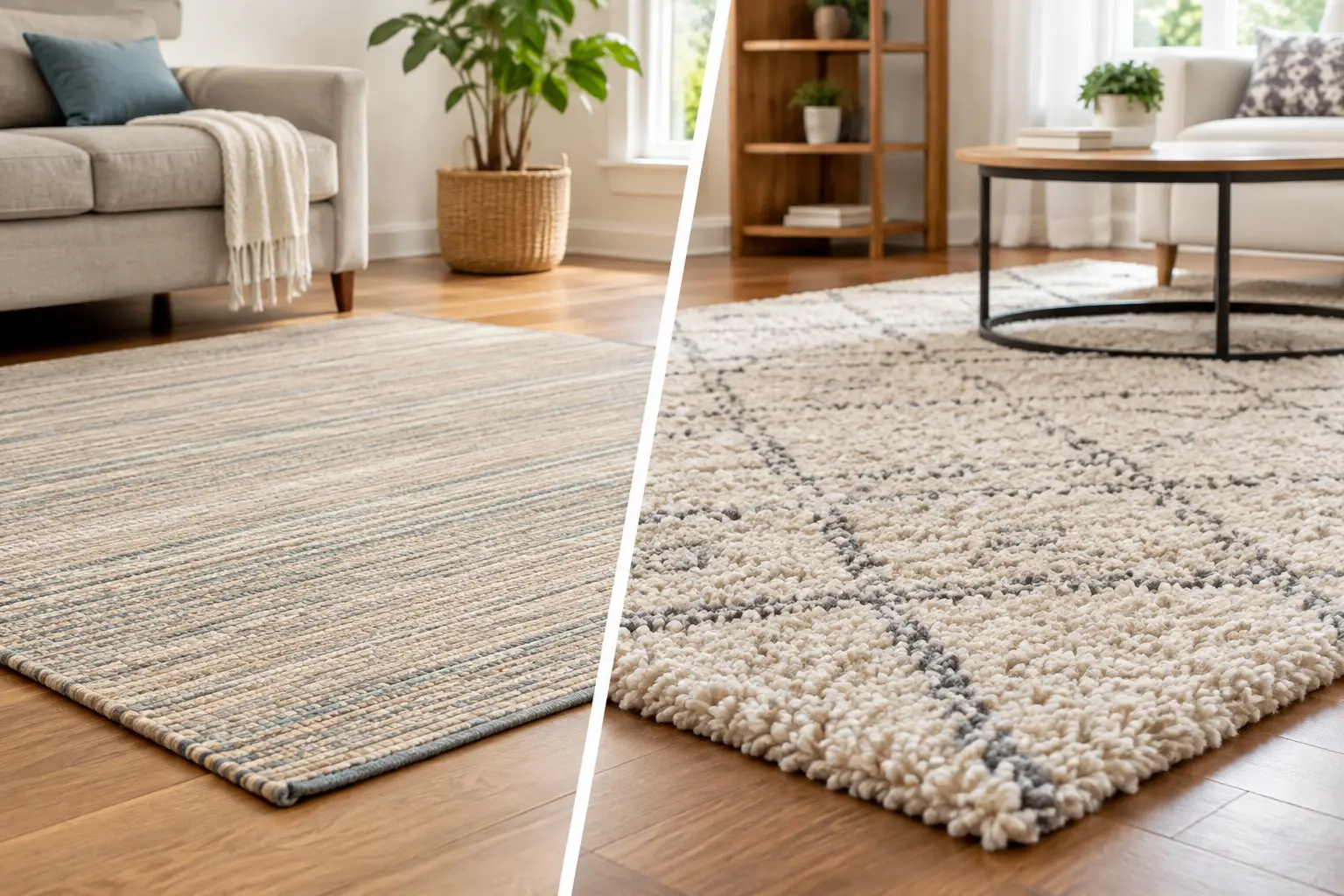
A rug’s construction changes more than the way it feels underfoot. It influences how furniture sits, how a room absorbs sound, how easily a doorway clears, and whether the finished space feels tailored, relaxed, or richly layered. In the choice between flatweave versus pile rugs, neither is inherently better. The right one is the piece whose structure supports the life and atmosphere of the room.
For collectors and design-minded homeowners, construction also offers a useful way to look beyond pattern. A low, tightly woven antique textile brings a different kind of presence than a hand-knotted wool rug with a soft, luminous surface. Both can carry history, craft, and quiet character. They simply do different work in an interior.
Flatweave versus pile rugs: the essential difference
A flatweave rug is woven without the raised knots or cut fibers that create a plush surface. Its pattern is formed directly through the interlacing of warp and weft threads, often producing a relatively thin, flexible textile. Kilims, dhurries, many Swedish-style rugs, and certain tribal weavings are familiar examples, though techniques and regional traditions vary considerably.
A pile rug has a raised surface made from fibers that stand above the foundation of the weave. In handmade knotted rugs, each knot contributes to that surface before the pile is sheared to its finished height. Persian rugs, Turkish Oushaks, Sultanabads, and many antique room-size carpets are pile rugs, with density, wool quality, and pile height differing from one weaving tradition to another.
The distinction may sound technical, but it is immediately visible. Flatweaves tend to show their structure crisply, with pattern, color shifts, and handwoven irregularities close to the surface. Pile rugs soften a room through depth and light absorption. Their fibers catch the eye differently as one moves around them, lending an aged rug a particularly nuanced, painterly quality.
When a flatweave is the natural choice
Flatweaves are especially compelling when a room needs pattern and warmth without visual or physical bulk. Their low profile keeps them practical beneath doors and in areas where chairs are pulled in and out frequently. In a dining room, for example, a flatwoven rug allows chair legs to move more easily than a deep pile while still giving the table a clear sense of place.
They also suit interiors where the architecture or furnishings already provide substantial texture. Think of wide-plank floors, linen upholstery, sculptural wood furniture, or a room with strong millwork. A fine vintage kilim can introduce color and graphic movement without making the composition feel overworked.
Because many flatweaves are lighter and more flexible than pile rugs, they are often an excellent choice for kitchens, hallways, entryways, and layered living spaces. A narrow antique runner can bring warmth to a passage without becoming an obstacle. A smaller flatweave laid over a larger natural-fiber foundation can create dimension while preserving a relaxed, collected feeling.
That said, “flatweave” should not be mistaken for casual or slight. An exceptional old kilim can carry remarkable visual authority. Its beauty lies less in softness and more in the clarity of its weave, the balance of its geometry, and the distinctive shifts in color created by naturally dyed or hand-spun fibers.
The practical character of flatweaves
A flatweave is generally easier to vacuum and less likely to trap crumbs, dust, and pet hair within a deep surface. This makes it appealing in hardworking spaces, although proper care still matters. Use a rug pad to prevent shifting, reduce friction against the floor, and add a little cushioning underfoot.
Many flatweaves can be used on either side, but this is not a universal rule. Some have a more finished face, directional pattern, delicate details, or condition considerations that make one side preferable. With older pieces, age and construction should guide the decision rather than a broad assumption about reversibility.
Why pile rugs create a different kind of comfort
Pile rugs offer a tactile quality that flatweaves cannot fully replicate. Even a low-pile antique rug has a softness and dimensionality that can make a room feel settled. This is why pile is so often at home in living rooms, bedrooms, libraries, and other spaces where comfort is part of the brief.
A hand-knotted wool rug can also bring a room together through its subtle variation. The pile reflects light differently depending on its direction, so a single field color may appear deeper from one end of the room and softer from the other. In antique Persian and Turkish rugs, this movement is part of the appeal. It keeps a restrained palette from feeling static.
Pile provides a measure of acoustic softness as well. In a room with stone, wood, glass, or high ceilings, it can temper echoes and create a more intimate atmosphere. This effect is not only practical. It changes the emotional register of the room, making a formal space feel more lived in and inviting.
Pile height is worth considering closely. A deep, plush pile feels luxurious but may not be ideal beneath a dining table or in a doorway with limited clearance. A low-pile antique Mahal, Sultanabad, or Oushak often offers the best of both worlds: enough surface texture to feel substantial, yet a profile that accommodates daily use and furniture placement gracefully.
Care considerations for pile rugs
Pile rugs reward regular, gentle maintenance. Vacuum without an aggressive beater bar when appropriate, attend to spills promptly, and rotate the rug periodically so traffic and sunlight are distributed more evenly. Wool has natural resilience and a pleasing ability to conceal everyday dust, but it benefits from professional washing when deeper cleaning is needed.
In high-traffic settings, a tightly woven, lower-pile rug is often more forgiving than a very soft, open-pile piece. This is where provenance and material knowledge become valuable. A well-made antique or vintage rug may show wear as part of its character, while a newer handmade rug may offer a cleaner surface and more uniform structure. Neither approach is superior. The choice depends on whether the room calls for patina, polish, or a considered balance of both.
Choose by room, not just by appearance
The quickest way to decide is to begin with how the room is used. In a dining room, flatweaves and low-pile rugs are usually the most practical because chairs need to move easily. For a bedroom, a pile rug offers a welcome first step in the morning, particularly when it extends generously beyond the bed.
Living rooms allow more freedom. A flatweave can sharpen a tailored, modern arrangement or support a layered, collected interior. A pile rug can anchor deep seating and make an open-plan room feel more grounded. If the furniture is visually substantial, such as a large sofa or carved wood casegoods, a pile rug’s softness may provide welcome contrast. If the furnishings are upholstered and textural already, a flatweave may bring needed definition.
Hallways and entries require a particularly honest assessment of traffic. A durable low-profile runner is often sensible, but it should still feel worthy of the first impression a home makes. A vintage flatweave with a strong border or a low-pile Turkish runner can offer both resilience and distinction.
Let the rug’s age and character inform the decision
Construction is only one part of the story. A vintage flatweave with softened colors may be the exact element that makes a newly renovated room feel less newly renovated. An antique pile rug may introduce depth to a minimal interior without adding clutter. The most successful choices often depend on contrast: crisp architecture with a timeworn textile, or streamlined furniture set against a rug with irregular handwoven movement.
For designers sourcing a one-of-a-kind piece, this is where a more personal process matters. Eskici Rugs has spent more than 30 years working in handmade rugs and understands that dimensions, budget, palette, and pile are not separate questions. They are all part of how a rug will live in a room.
Before committing, consider taking a sample of upholstery, paint, or wood finish into the rug selection process. Look at the rug in natural and evening light, and allow for the fact that handmade wool has variation by design. The right textile should not merely match the room. It should give the room a center of gravity, then leave space for everything around it to breathe.
A flatweave may be the quieter choice, a pile rug the more enveloping one. Either can become the piece that makes a room feel not just furnished, but deeply at home.