
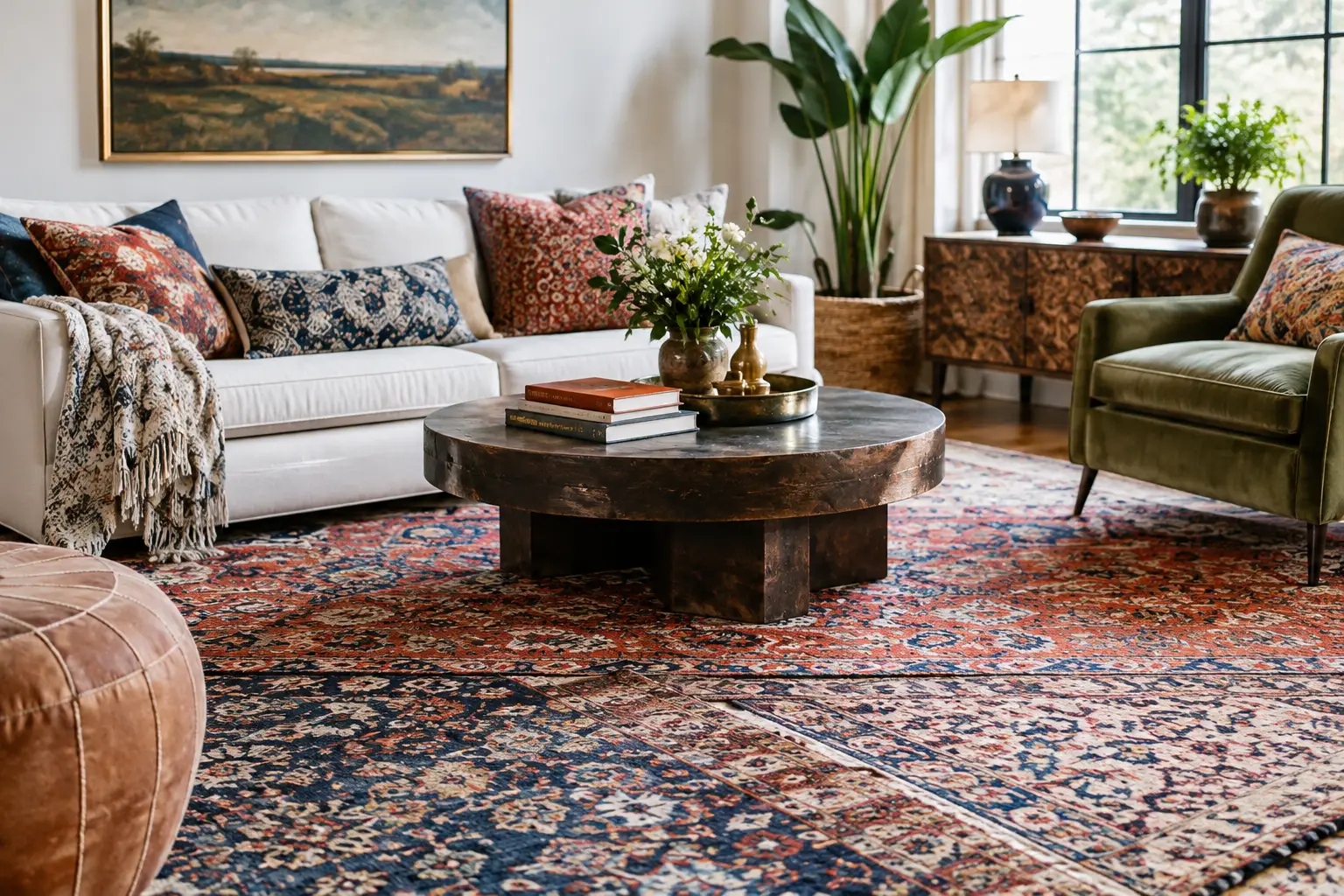
A maximalist room rarely begins with more. It begins with one convincing element: an antique rug whose color, scale, and lived-in surface give everything around it a reason to belong. The most compelling maximalist rug trends are not about visual noise. They are about rooms that feel collected over time, where a rug carries history and allows pattern, art, textiles, and furniture to sit together with ease.
For homeowners and designers drawn to richly layered interiors, handmade rugs offer a more lasting route than novelty-driven décor. A well-chosen Persian, Turkish Oushak, Sultanabad, or other vintage woven piece can bring movement and warmth without making a space feel overly styled. Its irregularity is often the point.
Maximalist Rug Trends Are Moving Toward Character
The current maximalist sensibility is more considered than the all-over excess of past decades. Instead of buying matching patterns in saturated colors, designers are mixing eras, materials, and motifs with a clear point of view. A carved walnut table may sit on a faded floral rug; a contemporary linen sofa may be grounded by an antique Persian with small-scale geometric detail.
This shift has brought renewed attention to rugs with nuance. Pieces with abrash, the subtle variation in color created by hand-dyed wool, feel especially at home in these interiors. So do rugs with softened borders, unusual palettes, visible repairs, and gentle signs of age. Their surfaces keep a room from feeling flat or overly new.
The goal is not to make every object compete. It is to create depth. Handmade rugs does this particularly well because it introduces pattern at floor level, where it can anchor the composition rather than crowd the eye line.
Pattern Mixing Starts With the Rug
A rug can be the most complex pattern in a room, but it does not have to be. The right choice depends on what else needs to be heard.
In a space with floral curtains, chinoiserie, or expressive artwork, a faded geometric rug may provide welcome structure. A tribal or village-woven piece with a restrained field and strong border can hold its own while giving the other patterns room to breathe. In contrast, a quieter room with solid upholstery and plaster walls may benefit from the layered florals of an antique Persian or a spacious Oushak design.
Scale matters as much as motif. Pairing a large-format rug pattern with smaller-scale cushions, lampshades, or upholstery prints creates hierarchy. When every pattern is the same size, the room can feel restless. A broad medallion or open field establishes a slower visual rhythm, while a small repeating textile pattern adds detail nearby.
Color is the bridge. Repeating even one or two tones from the rug in a pillow, painting, or chair helps an eclectic room feel intentional. This does not mean matching everything precisely. A rug’s faded rust can lead to terracotta, oxblood, blush, or warm brown elsewhere in the room. Its blue may appear again as ink, slate, denim, or washed indigo.
Let Age Do Some of the Styling
A new rug can certainly work in a maximalist interior, especially if it is handmade and designed with a thoughtful palette. Yet vintage and antique rugs bring an advantage that cannot be manufactured quickly: visual memory. Their softened wool, nuanced dyes, and slight asymmetry make rooms feel less arranged and more inhabited.
That said, age should never be treated as a substitute for condition. An antique rug needs to suit its intended use. A delicate piece may be better in a bedroom, library, or low-traffic sitting room than beneath a busy dining table. For an active family room, look for sturdy wool, a balanced pile, and a construction that can handle daily life with proper care.
The Return of Warm, Complicated Color
High-contrast black and white still has a place, but maximalist palettes are increasingly warmer and more atmospheric. Tobacco, saffron, moss, madder red, faded apricot, deep indigo, and clay create a sense of depth that works beautifully with wood, stone, brass, and natural linen.
This is one reason antique Oushak and Sultanabad rugs remain so relevant. Their softened colors and generous botanical motifs are expressive without feeling sharp. They can hold a room with patterned walls or upholstered furniture, but they also lend a quiet, welcoming presence to simpler spaces.
A rug need not be bright to be bold. A low-contrast antique rug in ivory, camel, faded rose, and pale blue may be the more sophisticated choice for a room already filled with books, art, and collected ceramics. Maximalism is not always saturation. Often, it is the confidence to work with many subtle tones at once.
Layering Rugs Without Losing the Room
Layered rugs remain one of the most useful expressions of maximalist style, particularly in large rooms, lofts, and spaces with wall-to-wall carpet. The approach works best when there is a practical reason behind it: defining a seating area, bringing softness to a wide floor plan, or allowing a smaller antique rug to shine where it would otherwise look undersized.
A larger, quieter foundation rug can support a more intricate vintage piece on top. Flatwoven wool, natural jute, and low-profile neutral rugs are common choices because they offer texture without competing for attention. The upper rug should feel clearly purposeful, not like an afterthought placed at an awkward angle.
Proportion is essential. Leave enough of the base layer visible to frame the upper rug, and make sure furniture relates to the composition. In a living room, the primary rug should generally allow at least the front legs of the major seating pieces to rest on it. A smaller accent rug can then sit within that footprint, perhaps beneath a coffee table or toward the center of the conversation area.
Layering is less successful when it is used to solve a sizing mistake. A beautiful 5-by-8 rug cannot always compensate for a room that truly needs an 8-by-10 or 9-by-12 foundation. Start with the room’s scale, then use layering to add texture and emphasis.
One-of-a-Kind Rugs Make Maximalism Personal
The most interesting maximalist interiors resist repetition. They include the inherited cabinet, the painting found on a trip, the chair reupholstered in a fabric that felt impossible to leave behind. A one-of-a-kind rug belongs naturally in that story because it cannot be duplicated across hundreds of homes.
For designers, this singularity can become the project’s organizing idea. A vintage rug may establish the palette for custom upholstery, wall color, and decorative lighting. For homeowners, it can be a way to build a collected room gradually rather than buying a complete look at once. The best pieces continue to offer something new: an unexpected green in the border, a hand-drawn flower, a change in wool texture as the light shifts through the day.
Eskici Rugs has spent decades working with handmade rugs, and that experience is most useful when a room calls for a piece with specific dimensions, color, and character. The right rug is rarely just a category. It is a particular object with a particular role in a particular room.
How to Keep a Maximalist Room Composed
The difference between layered and cluttered often comes down to restraint in a few key places. Give the eye areas of calm, whether that means a solid sofa, quiet painted walls, open floor around a rug, or a limited number of large furniture forms. A room can hold abundant pattern when its structure is simple.
Texture also prevents pattern mixing from becoming too literal. Pair the woolen depth of an antique rug with smooth lacquer, aged wood, linen, leather, woven shades, or ceramic. These material contrasts create richness without requiring another printed surface.
Finally, honor the rug’s actual colors rather than forcing it into a rigid palette. Handmade pieces often contain more shades than first appear. Live with a rug sample or images in the room’s natural and evening light, then notice which undertones emerge. That small act of looking closely leads to rooms that feel settled rather than assembled.
A maximalist interior does not need to announce itself all at once. Begin with the rug that feels impossible to replace, let its colors guide the next decision, and allow the room to become more personal with time.