
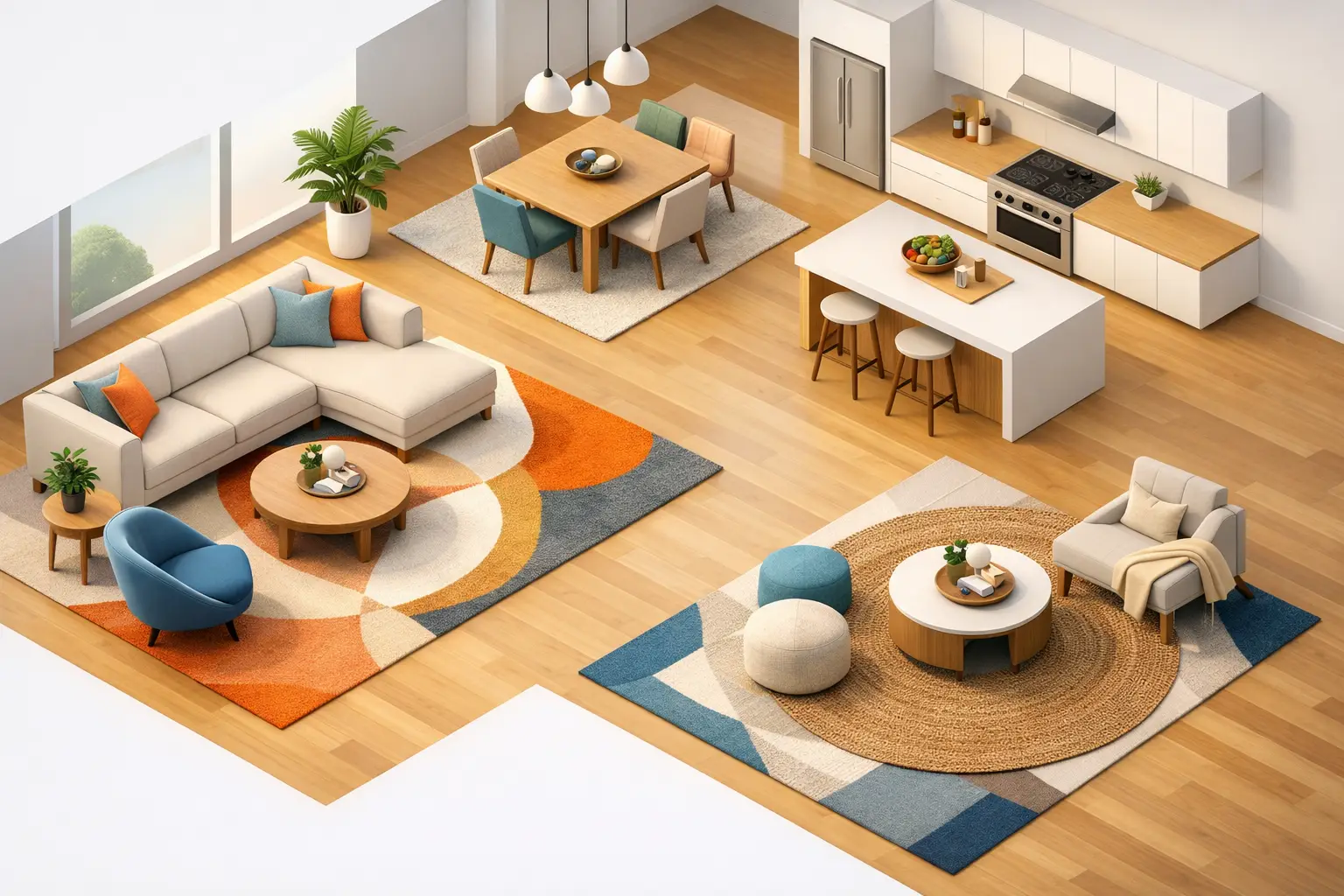
A beautiful open floor plan can feel expansive, light-filled, and wonderfully social. It can also leave a room feeling unfinished when the furniture appears to float without definition. The best rugs for open floor plans bring order to that openness. They establish distinct places to gather, dine, work, or rest while preserving the visual ease that made the layout appealing in the first place.
A rug is not simply a finishing layer in a large shared space. It is an architectural element in soft form. With the right scale, color, and character, a handmade rug gives each area a sense of purpose without requiring walls, partitions, or an excess of furniture.
Choosing the Best Rugs for Open Floor Plans
The first decision is not pattern or color. It is the role each rug needs to play. In an open-plan home, rugs should clarify the room’s natural activity zones: the seating area, dining space, breakfast table, reading corner, or entry path. Each one can feel individual, but the collection should still read as part of one considered interior.
Think of rugs as punctuation rather than borders. A large living room rug creates a visual pause around a conversation area. A dining rug gives the table weight and permanence. A smaller vintage piece at an entry can offer a moment of texture before the larger space opens up. The goal is gentle definition, not a series of disconnected islands.
Scale is where many open layouts succeed or fail. A rug that is too small makes even carefully selected furniture look temporary. In a generous room, it is usually better to choose the larger size and let the rug hold the full seating arrangement together.
Let the Architecture Set the Rug Size
Begin by measuring the furniture grouping, not only the empty floor around it. For a living area, the rug should ideally extend beneath the front legs of every major upholstered piece. In a more spacious arrangement, all furniture legs can sit on the rug, creating a composed and generous field beneath the seating.
Leave a visible margin of flooring around the rug, but do not treat that margin as a fixed rule. A narrow urban loft and a broad kitchen-living room will call for different proportions. What matters is that the rug feels intentionally related to the room rather than dropped into its center.
Living and dining areas need their own logic
In a combined living and dining room, the two rugs do not need to match, nor should they compete. The living room often benefits from the larger, quieter piece because it occupies the most visual territory. A dining rug can introduce another note of pattern or color, provided it shares a thread with the first rug: a similar warmth in the ground color, a related blue, a softened red, or a comparable level of age and texture.
For dining, allow enough room for chairs to remain on the rug when pulled back. A rug that ends just beneath the chair legs feels awkward in use and can make the table seem undersized. Flatwoven and low-pile handmade rugs are particularly practical here, though a durable, lower-pile vintage Persian rug can also work beautifully with a substantial table.
Choose Character, Then Build Continuity
One-of-a-kind rugs are especially compelling in open plans because they prevent a large room from feeling overly uniform. Their subtle irregularities, softened colors, and signs of handwork introduce the depth that new construction and broad expanses of flooring can sometimes lack.
The most successful pairings are connected in mood, not duplicated in design. A faded Oushak with a spacious, softly drawn pattern may sit beautifully near a more detailed antique Persian rug if both carry a warm, timeworn palette. A restrained Sultanabad can provide a calm foundation for a dining area, while a smaller tribal or geometric weaving adds movement in an adjacent entry or reading nook.
There is a useful trade-off to consider. Highly decorative rugs can define a zone with remarkable confidence, but several bold patterns in one sightline may make an open floor plan feel busier than intended. If the room already has strong millwork, dramatic lighting, or active stone, choose a rug with a more open field and let its wool, abrash, and quiet variation do the work.
Styles that suit open interiors
Oushak rugs are often a natural choice for large, airy rooms. Their graceful scale and softened palettes bring warmth without visual heaviness, especially in living rooms with linen upholstery, wood, and natural stone. Sultanabad rugs tend to offer more structure and can ground traditional, transitional, and collected interiors with their substantial drawing and balanced color.
Antique Persian rugs bring intricacy and history, making them especially effective where a room needs focus. In an open plan, use them where the eye naturally lands: beneath a dining table, within a library corner, or in a seating arrangement that benefits from a more intimate feeling. Turkish vintage rugs, with their worn surfaces and lively geometry, can create an appealing counterpoint to cleaner-lined contemporary furniture.
The right choice depends on the room’s existing materials. Pale oak, plaster, and ivory upholstery may welcome a rug with earthy reds, faded indigo, tobacco, or muted saffron. Dark cabinetry or richly stained floors often benefit from a lighter ground color that lifts the composition and keeps the floor plane from becoming too heavy.
Use Color to Create a Conversation
In a closed room, a rug can carry the entire color story. In an open floor plan, it has to participate in a larger conversation. Before selecting multiple rugs, identify two or three colors that already appear throughout the connected space. They may come from upholstery, artwork, cabinetry, tile, or window treatments.
Then allow each rug to interpret those colors differently. One may feature a quiet ivory field with traces of blue and rust, while another leans into rust with smaller touches of blue. This variation feels layered and natural. Identical colors and matching borders, by contrast, can make handcrafted pieces look overly coordinated.
Pay attention to contrast as well. A pale rug on pale flooring can be serene, but it needs enough pattern, texture, or tonal shift to establish its own presence. A deep rug on dark wood can be dramatic, though it may visually shrink a zone if the room lacks adequate light. Neither approach is wrong. The best decision follows the atmosphere you want the space to hold.
Placement Should Feel Deliberate, Not Precious
A common mistake is centering every rug within the architecture. Open plans rarely work that neatly. A rug should be centered on its furniture arrangement, which may sit slightly off-center in the larger room. Let the sofa, chairs, table, and circulation paths determine placement.
Keep major walkways clear, particularly between the kitchen and dining area or between an entry and the living room. A rug can cross a route, but it should not create a narrow, awkward passage around its edge. When a room contains several zones, enough exposed flooring between rugs helps each area breathe.
Avoid placing rugs so close together that they appear to touch or nearly overlap. That small gap is valuable. It signals that the spaces are related but distinct. In a very large room, a shared material cue, such as wool texture or a common warm undertone, will provide more cohesion than forcing rugs into symmetry.
Favor Materials That Improve With Living
Open-plan homes tend to concentrate activity. Dining chairs move, children play across the living room, and pets often claim the warmest patch of afternoon light. Wool remains an excellent choice for these spaces because it is naturally resilient, softly textured, and forgiving of everyday use. Its depth of color also gives handmade rugs a presence that synthetic alternatives rarely achieve.
Vintage and antique rugs can be practical as well as beautiful, especially those with an already softened surface and a stable, well-woven foundation. Their age should be understood as character, not fragility, but placement matters. Reserve especially delicate antique pieces for lower-traffic zones, and consider a quality rug pad for comfort, stability, and protection.
An open floor plan does not need matching rugs to feel resolved. It needs pieces with a shared sensibility, enough scale to hold their ground, and the confidence to let each zone become its own small world. Choose the rug that makes the room feel more lived in, more grounded, and a little more yours.