
A rug can look beautifully textured from across the room and still reveal very little about how it was made. The most reliable way to understand a piece is to turn it over, look closely, and let its construction speak. Learning how to tell if a rug is handmade gives you more than a useful shopping skill – it helps you recognize the quiet irregularities, material depth, and human presence that make a rug feel at home in a layered interior.
A handmade rug is not necessarily antique, expensive, or perfectly suited to every room. But it is made with an attention to material and process that machine-made rugs rarely replicate. Whether you are considering a faded Turkish vintage rug for a living room or a finely detailed Persian piece for a more formal setting, these are the details worth noticing.
Start With the Back of the Rug
The back is often the clearest place to see a rug’s true construction. On a hand-knotted rug, the pattern on the reverse should be visible in the same colors and general detail as the front. It may be slightly less crisp, particularly on a worn vintage piece, but you should be able to see individual knots and the structure of the design rather than a smooth backing material.
Machine-made rugs tend to have an unusually uniform back. Their designs can appear very precise, sometimes almost printed, and the weave may look mechanically regular from edge to edge. Many also have a stiff backing, latex coating, or fabric layer that conceals the construction altogether.
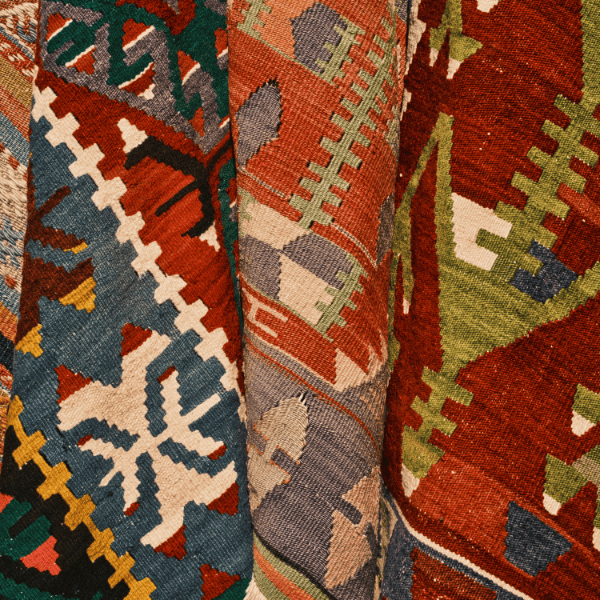
Handwoven flatweaves, including kilims and many tribal styles, have a different character. Their backs and fronts are often nearly identical because the design is created through interwoven weft threads rather than piled knots. Look for a supple textile structure, slight shifts in line, and naturally integrated color.
Look at the Fringe, Not Just the Pile
Fringe is one of the fastest clues, though it should never be the only one. On a hand-knotted or handwoven rug, fringe is usually the visible continuation of the rug’s foundation threads. It emerges directly from the body of the weave, rather than being sewn onto an already finished edge.
A machine-made rug often has fringe added afterward for appearance. If you gently examine where the fringe meets the rug, it may look stitched, glued, or attached as a separate trim. This does not make a rug less useful, but it does tell you that the fringe is decorative rather than structural.
There are exceptions. Some handmade rugs have had their original fringe repaired, shortened, or secured over time, especially antique and vintage pieces that have been carefully restored. In those cases, the reverse of the rug and the edge finish provide a more complete answer.
Notice the Beauty of Small Irregularities
Handmade rugs are shaped by the hands that weave them. A border may wander very slightly. A repeated floral motif may be a touch more open on one side than the other. The rug may not be perfectly rectangular when laid flat. These are not flaws to correct or dismiss. They are often signs of an authentic woven process.
The key is to distinguish gentle variation from poor construction. In a well-made handmade rug, the overall design still feels balanced and intentional. Its irregularity has warmth and rhythm. By contrast, uneven pile loss, weak edges, or severe distortion may point to condition concerns that deserve a closer assessment, particularly when purchasing an older piece.
Color variation is another meaningful detail. Hand-dyed wool often carries subtle tonal movement known as abrash, where one section of the field shifts slightly warmer, cooler, lighter, or deeper than another. It can happen when yarn is dyed in separate batches or when natural dyes respond differently to the fiber. In a room, abrash gives a rug visual depth that changes gently with daylight.
Check the Materials With Your Hands
Most enduring handmade rugs are made from natural materials, especially wool, cotton, silk, or a combination of these fibers. Wool has a resilient, slightly springy hand and a softness that becomes more apparent with use. It may have a faint natural lanolin feel, although age and cleaning can reduce it. Cotton is commonly used for the foundation, while silk may define highlights in fine rugs or create a luminous, lower-profile pile.
Synthetic fibers are not automatic proof that a rug is machine-made, but they are more common in mass-produced construction. Polyester, polypropylene, and nylon can mimic wool from a distance, yet they often feel slicker, more uniform, or less substantial in the hand. A natural wool rug also tends to hold a richer, less flat range of color.
Material alone cannot settle the question. Modern handmade rugs may use blends, and some hand-tufted rugs use wool pile over a glued canvas foundation. Instead, treat fiber as one part of a broader reading of the rug.
Understand the Difference Between Hand-Knotted, Handwoven, and Hand-Tufted
Not every rug described as handmade is made in the same way. This distinction matters for longevity, repairability, price, and the kind of character you can expect over time.
A hand-knotted rug is built knot by knot on a loom. Each knot forms part of the pile, creating a durable textile with a visible foundation and a design that carries through to the back. Fine Persian, Turkish Oushak, and many antique rugs are made this way. Depending on materials, density, and condition, a well-cared-for hand-knotted rug can remain in use for generations.
A handwoven rug, often called a flatweave, is woven without a raised pile. Kilims, dhurries, and certain Scandinavian-style rugs fall into this category. They are handmade and often remarkably durable, though their lower profile can make them better suited to areas where a plush surface is not required.
A hand-tufted rug is made by pushing yarn through a fabric backing with a tool, then applying latex and a secondary backing to hold the pile in place. It is technically handmade, but it is not hand-knotted. Hand-tufted rugs can offer an inviting look at a more accessible price, yet their glued construction generally gives them a shorter lifespan and makes restoration more limited. If a seller uses the word handmade, ask which construction they mean.
Read the Edges and Corners
The side edges of a handmade rug are called selvedges. On hand-knotted rugs, they are typically wrapped or overcast by hand and may show slight variation in thickness or tension. They should feel integrated with the rug, not like a separate binding applied after the fact.
Corners can be especially revealing. A handmade rug’s corner may show the natural turn of the weaving process, with minor asymmetry and a continuation of the foundation threads. Machine-made corners often appear exceptionally standardized, with uniform stitching and a finished edge that looks separate from the woven body.
For vintage and antique rugs, inspect these areas for wear. Fraying, exposed foundation, and old repairs are not necessarily reasons to walk away. They are part of a rug’s condition story and should be considered alongside the piece’s age, rarity, scale, and intended placement. A delicate antique may be ideal in a quiet bedroom or under a dining table with thoughtful use, while a more resilient vintage wool rug may be better for a busy living room.
Use Price and Provenance Carefully
Price can be a signal, but it is not proof. A low price does not always mean a rug is machine-made, particularly when a vintage rug has fading, repairs, or an uncommon size. Likewise, a high price can reflect branding, retail overhead, or decorative demand rather than exceptional craftsmanship.
Provenance and clear descriptions are more useful. A thoughtful seller should be able to describe the rug’s construction, materials, approximate age, origin when known, and condition. For one-of-a-kind pieces, photographs of the back, fringe, and close-up pile are part of an honest presentation. If the details are vague, ask direct questions before making a decision.
How to Tell If a Rug Is Handmade When Shopping Online
Online shopping asks you to read a rug through photographs, so prioritize images that show more than the styled front view. Look for a full image of the reverse, close-ups of the pile and edge, and clear views of both ends. A photo taken in natural light can also reveal the tonal variation and surface texture that make wool so compelling.
Descriptions should name the construction rather than relying only on broad terms like artisan-made or handcrafted. For a hand-knotted rug, details such as wool pile, cotton foundation, woven fringe, age, and origin offer useful context. For a vintage piece, condition notes should be specific about areas of wear, repairs, or variations in pile.
A handmade rug does not need to be flawless to be exceptional. The most memorable pieces often carry a softened palette, an off-center detail, or the gentle evidence of a long life. Choose the rug whose construction feels honest and whose character gives the room something no mass-produced surface can quite provide.