
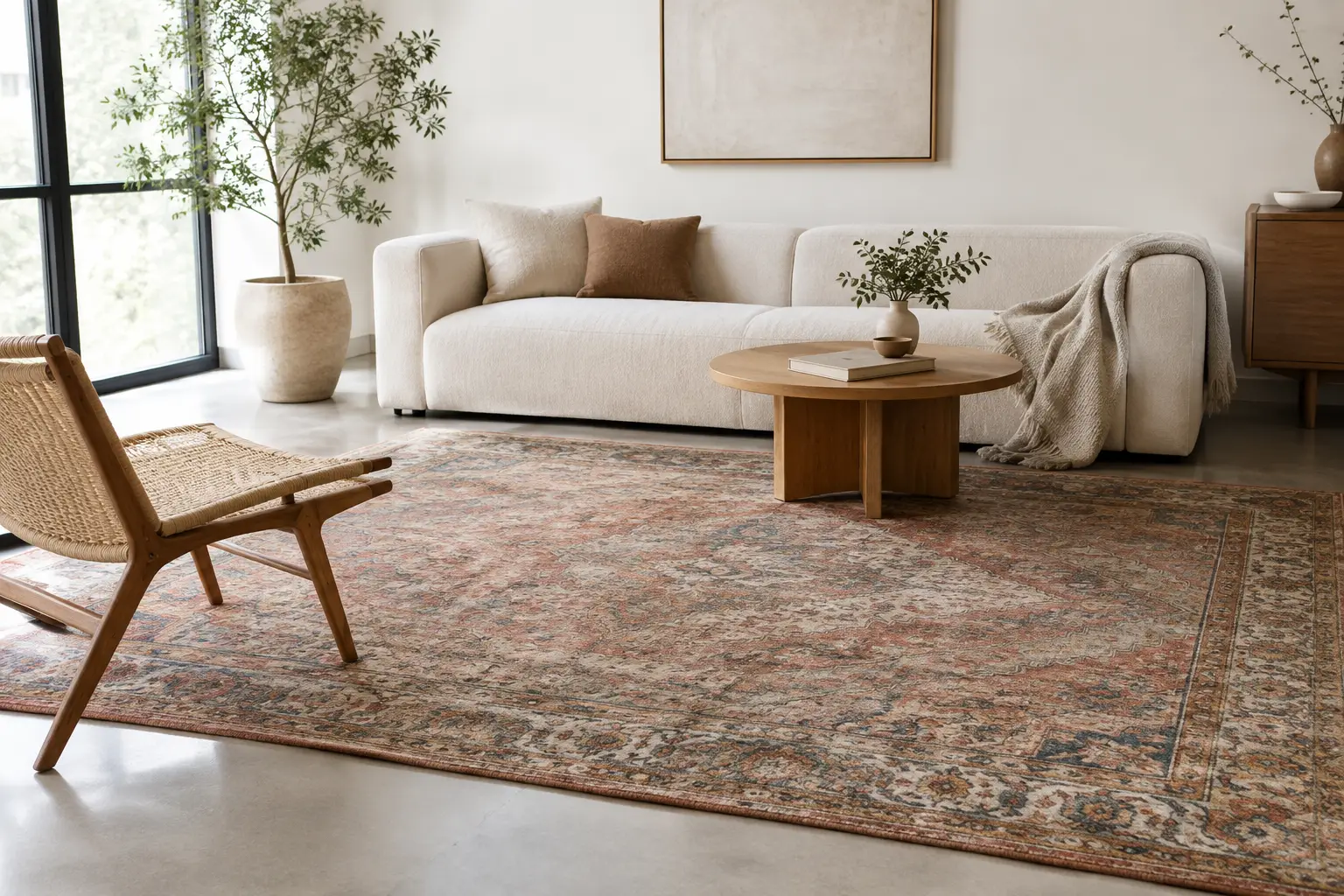
A room with plaster-white walls, a low linen sofa, and pale oak floors can be calming, but it can also feel unfinished. A vintage rug for minimalist interiors resolves that tension without asking the room to become busier. It brings softness underfoot, a lived-in sense of history, and the subtle irregularity that gives a restrained space its depth.
The goal is not to place a highly decorative object in an otherwise spare room and call it contrast. The most successful minimalist rooms are edited, not empty. A handmade vintage rug can be the element that makes clean lines, natural materials, and quiet architecture feel personal rather than severe.
Why Vintage Rugs Work in Minimalist Rooms
Minimalism often relies on a limited palette and a small number of carefully chosen materials. Without variation in texture, those choices can read as flat. Vintage rugs introduce tonal movement through hand-spun wool, faded vegetable dyes, abrash, and the small shifts in pile that come from a life well lived.
That character matters because it is different from visual clutter. A softly worn Persian, Turkish Oushak, or Sultanabad rug may contain several colors and motifs, yet still feel remarkably calm when its palette has settled over time. Gentle rust, tobacco, faded indigo, warm ivory, and softened rose tend to sit comfortably beside plaster, stone, oak, linen, and leather.
There is also a useful design counterpoint at work. Minimalist furnishings are often new, streamlined, and intentionally quiet. A vintage textile adds age and handwork to that setting. Rather than competing with contemporary pieces, it can make them feel more considered.
Choosing a Vintage Rug for Minimalist Interiors
The right rug should support the room’s overall composition before it makes a statement on its own. Begin with scale, then consider color and pattern. This order prevents a common mistake: falling for a beautiful piece that is too small to properly anchor the furniture.
Let the rug establish the room’s proportions
In a living room, the rug should generally be large enough for at least the front legs of the sofa and chairs to rest on it. When space and budget allow, placing all major seating on the rug creates a more generous, finished arrangement. A small rug floating in the center of a large room can make even beautiful furniture look disconnected.
For dining rooms, allow enough room for chairs to remain on the rug when pulled back. In bedrooms, choose a rug that extends beyond the sides and foot of the bed, or use runners on either side for a lighter, more architectural approach. Hallways benefit from vintage runners with a narrow, elongated field, where pattern can bring life to a transitional space without adding furniture or objects.
Minimalist interiors are especially sensitive to proportion. When there are fewer elements in a room, each one carries more visual weight. Measure before shopping, and leave a consistent reveal of flooring around the perimeter when appropriate. That breathing room helps the rug feel intentional.
Choose softened color, not necessarily neutral color
A minimalist palette does not require a beige rug. In fact, an overly uniform neutral scheme can make a room feel less inviting. Consider a rug with a quiet base color and a few muted accents: an antique ivory field with faded brown and blue, a low-contrast red softened by age, or a dusty green that echoes the landscape outside.
Look at the colors already present in the room, including fixed finishes. The undertone of your flooring, the warmth of painted walls, and the metal finish of lighting all influence whether a rug feels harmonious. Cool gray stone may benefit from a rug with wheat, clay, or faded terracotta notes. Honey-toned wood often looks particularly good with indigo, soft denim blue, and restrained burgundy.
If the room is already filled with warm neutrals, a vintage rug can provide contrast through temperature rather than intensity. A weathered blue or muted charcoal detail may be all that is needed. Conversely, in a room with strong black accents or cool modern furniture, a softly faded rug in warm tones can keep the atmosphere from becoming austere.
Use pattern as texture
Pattern is not the enemy of minimalism. The issue is whether it overwhelms the eye or gives the eye somewhere to rest. A faded allover pattern, an open Oushak design, or a rug with a generously scaled botanical motif often reads as texture from across the room.
This is where vintage pieces have an advantage over sharp, high-contrast reproductions. Time naturally softens color transitions and reduces the graphic force of a pattern. A centuries-old design can feel surprisingly modern when its palette is quiet and its field is open.
A room with plain upholstery can usually carry more pattern underfoot. If your sofa has a pronounced weave, bold stripe, or strong silhouette, choose a rug with a simpler field or lower contrast. It depends on how much visual activity is already present, not on a strict rule about how many patterns a room may contain.
Match the Rug’s Character to the Architecture
A rug should not merely match the sofa. It should respond to the room itself. In a historic home, an antique Persian or Turkish rug can echo original millwork, aged brass, and old wood floors without making the space feel period-specific. In a newer home, that same piece introduces a needed layer of patina against clean drywall and contemporary windows.
Open-plan spaces often benefit from rugs with enough presence to define distinct zones. A larger, softly colored Sultanabad can give a living area its own identity while remaining visually connected to an adjacent dining space. If several rugs are visible at once, look for a shared note – perhaps similar warm grounds, a recurring indigo accent, or comparable levels of fading – rather than matching them exactly.
For small rooms, resist the assumption that a pale rug is always best. A darker vintage rug can create intimacy and visual grounding, especially when walls and furnishings remain light. The key is to avoid a dense, high-contrast design that chops the room into smaller pieces.
Honor the Material and the Maker
Most well-made vintage rugs are wool, and wool is particularly suited to daily living. It has natural resilience, a pleasing hand, and a depth of color that synthetic fibers rarely replicate. Variations in weave, pile, and tone are part of the appeal, not defects to be corrected.
That said, a vintage rug should be chosen with an honest view of how it will be used. A delicate antique with lower pile may be ideal in a bedroom, library, or formal sitting room. A sturdier vintage Turkish or Persian rug may be the better choice for an active living room, entry, or dining area. A quality rug pad is worthwhile in either case: it adds cushioning, helps prevent shifting, and reduces wear from friction against the floor.
Expect some signs of age. Minor repairs, gentle fading, and slight irregularities are evidence of a handmade textile’s history. What matters is that the rug is structurally sound, cleaned appropriately, and suited to the demands of the space. This is also why curation matters. A one-of-a-kind rug is easiest to choose when someone who understands the inventory can speak clearly about its condition, construction, color, and scale.
Give the Room Time to Settle
Once a vintage rug is in place, edit before adding more. It may be the missing warmth your room needed, making extra pillows, wall décor, or decorative accessories unnecessary. Let its color inform a single ceramic vessel, a book jacket, or a throw, then allow the rest of the room to stay quiet.
A vintage rug does not make minimalism less disciplined. It makes it more human. Choose the piece that feels grounded in the room, generous in scale, and quietly alive with the marks of the hand. The result is not a space that looks decorated, but one that feels genuinely inhabited.