
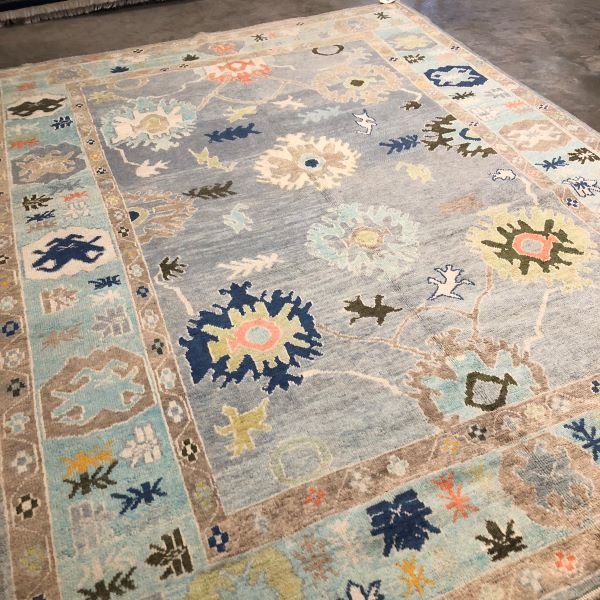
The rooms that stay with you rarely rely on perfect matching. More often, they hold a certain balance – softness against structure, age against freshness, restraint against warmth. A Turkish Oushak rug often does exactly that. This turkish oushak rug guide is for homeowners and designers who want more than a beautiful floor covering. It is for anyone looking for a piece with quiet character, decorative range, and a sense of history that settles naturally into a well-lived interior.
What sets a Turkish Oushak rug apart
Oushak rugs come from western Turkey, with roots tied to one of the country’s most recognized weaving traditions. They are admired for a few qualities that are easy to identify once you know what to look for: luminous color, generous pattern, and a softer, airier handle than many tightly packed workshop rugs from other regions.
The palette is often the first thing people notice. Turkish Oushaks are known for nuanced tones rather than sharp contrast. Think faded terracotta, muted gold, pale blue, tobacco, sand, sage, rose, and worn ivory. Even when the design is large in scale, the overall impression tends to feel gentle. That is part of their appeal in American interiors where rooms often need warmth without heaviness.
The drawing also matters. Many Oushak rugs feature spacious medallions, open fields, vinework, and botanical motifs that read clearly from across the room. Compared with denser Persian patterns, they can feel more relaxed and architectural. That openness makes them especially effective in layered interiors where furniture, art, and textiles all need room to speak.
A practical Turkish Oushak rug guide for buyers
If you are shopping for an Oushak, the first question is not whether you like the style. It is whether you want the rug to lead the room quietly or more visibly. Oushaks can do both, but the right choice depends on scale, color, and the age of the piece.
Vintage, antique, and newer handmade pieces
Antique and vintage Oushaks tend to have the softest color and the most lived-in visual depth. Their wool often carries a patina that newer rugs cannot imitate convincingly. For collectors and design professionals, that age is part of the value. The rug brings not only pattern but atmosphere.
Contemporary Turkish Oushak rugs carry the same tradition from soft colors to open field design and lustrous wool.
How to judge color
Color should be read in context, not in isolation. A rug that appears beige online may reveal peach, apricot, pale gold, or gray-green undertones once it is in a room. That is especially true with Oushaks, whose vegetable-dyed or softly faded palettes can shift throughout the day.
In north-facing rooms, warmer Oushaks with terracotta, camel, or honey notes can keep the space from feeling flat. In bright rooms, washed blues, pale greens, and soft ivory grounds can feel especially elegant. If your furniture is already richly colored, a quieter rug may create better balance. If the room is largely tonal, a rug with a little more contrast can keep it from drifting into sameness.
What quality looks like
Quality in an Oushak is not always about precision. In fact, some of the most appealing pieces have small irregularities in drawing and wear. What matters more is the integrity of the weave, the character of the wool, and whether the rug feels visually resolved.
Look for strong, natural color variation, a balanced composition, and a pile that wears evenly. Low pile is not a flaw in a vintage Oushak. It is often part of the beauty. But weak foundation, brittle areas, or repairs that interrupt the design deserve closer attention. In a well-curated setting, those issues should already be considered before a piece is offered.
Where Oushak rugs work best
One reason designers return to Oushaks again and again is their flexibility. They are distinctive, but not demanding.
Living rooms
An Oushak is often at its best in a living room where it can anchor a full furniture arrangement. The classic approach is to place at least the front legs of seating on the rug, which helps the room feel connected rather than scattered. Large-pattern Oushaks are especially effective here because the motifs remain legible beneath a coffee table and around upholstery.
If the room includes modern silhouettes, plaster walls, linen upholstery, or warm woods, an Oushak can soften the architecture without making the space feel traditional. In more collected interiors, it becomes part of a broader layering story.
Dining rooms
Dining rooms benefit from Oushaks with enough scale to extend well beyond the table. This is partly practical, since chairs need room to move, but it is also visual. A rug that is too small can make the entire room feel underfurnished.
Pattern density matters here. Open designs generally read better under dining furniture than highly intricate allover motifs. Lower pile can also be a practical advantage, as chairs move more easily across the surface.
Bedrooms and hallways
In bedrooms, Oushaks bring warmth in a quieter register than darker, denser antiques. A large rug under the bed creates softness and structure, while runners at the bedside can add a more informal, layered feel. In hallways, vintage Oushak runners work beautifully because their length and repeating motifs guide the eye without overwhelming narrow architecture.
Sizing matters more than most people expect
A beautiful rug in the wrong size often feels disappointing for reasons that are hard to name until you see it in place. In living rooms, too small usually means the rug floats in the center like an afterthought. In bedrooms, it can leave the room feeling visually top-heavy. In dining rooms, it can turn practical movement into daily friction.
When in doubt, go larger. Oushaks tend to reward generous placement because their open pattern and softened palette do not crowd a room. They create a grounded base rather than visual clutter. For designers sourcing one-of-a-kind pieces, this is often the difference between a room that looks simply furnished and one that feels fully considered.
Styling a Turkish Oushak rug without making it feel predictable
The easiest mistake with heritage rugs is overcommitting to one stylistic direction. An Oushak does not need a room full of antique references to make sense. In fact, it often becomes more compelling when paired with cleaner silhouettes, contemporary lighting, or sculptural furniture.
That tension is what gives the room life. A Oushak under a tailored sofa, a dark wood table, or even a minimal upholstered bed frame can feel balanced and current. The rug contributes age and softness, while the surrounding pieces keep the room crisp.
Texture is equally important. Oushaks pair naturally with linen, oak, aged brass, leather, matte plaster, and hand-thrown ceramics. These materials share a certain honesty. They are not overly polished, and they age well together.
Why Oushaks remain relevant
Trends shift quickly, but Oushaks have remained in serious interiors because they solve multiple design problems at once. They soften modern rooms, calm traditional ones, and bring pattern without noise. They are decorative, but rarely flashy. They hold history without feeling museum-like.
That balance is not easy to find. It is one reason thoughtfully selected Oushaks continue to resonate with collectors, homeowners, and trade professionals alike. At Eskici Rugs, that appeal is less about nostalgia than about permanence – the kind that lets a room feel settled, personal, and beautifully layered over time.
If you are choosing one, trust the piece that makes the room feel quieter, warmer, and more complete the moment you picture it in place. The right Oushak does not fight for attention. It simply makes everything around it look better.