
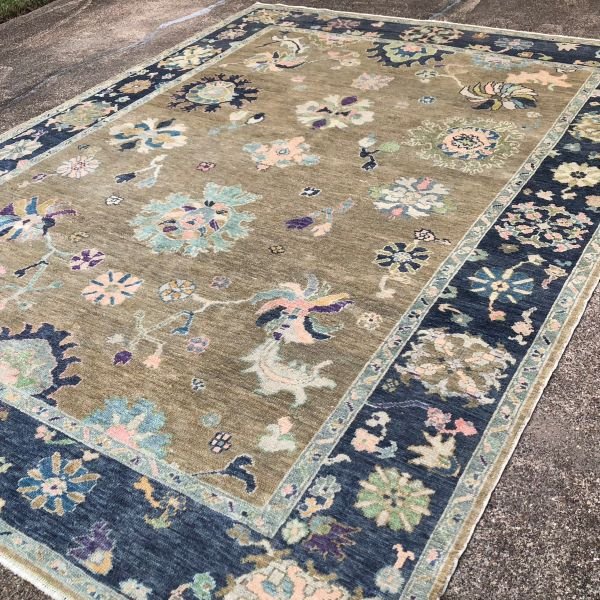
A room can feel technically complete and still fall flat until the right rug enters it. That is often the moment people start asking, what is an Oushak rug, and why does it seem to bring such ease, softness, and presence to a space without overpowering it.
Oushak rugs have a way of anchoring a room quietly. They are known for generous pattern, luminous wool, and palettes that tend to soften rather than sharpen an interior. For designers and homeowners who want warmth, history, and a sense of restraint, Oushak rugs often sit in a very particular sweet spot – decorative, but not busy; traditional, but rarely rigid.
What Is an Oushak Rug?
An Oushak rug is a handmade wool rug woven in the tradition of Ushak, a town in western Turkey with a long and important rug-weaving history. The name is often spelled Oushak in the US market, though Ushak is the direct geographic spelling. These rugs became especially well known for their large-scale motifs, supple handle, and softly faded color stories.
Historically, Oushak rugs were woven for both local use and export, and they have been admired for centuries. Many antique examples were produced during the Ottoman period and found their way into European interiors, where they became associated with gracious, layered rooms. That legacy still shapes how they are appreciated today.
When people refer to an Oushak rug now, they may mean a true antique from the region, a antique Turkish rug woven in that tradition, a contemporary Turkish Oushak or a newer rug inspired by the Oushak design. The distinction matters. Not every rug labeled Oushak is equally valuable, or equally faithful to the original weaving tradition.
What Makes Oushak Rugs Distinctive?
The quickest answer is balance. Oushak rugs are decorative, but they rarely feel fussy. Their patterns are often open and spacious, which gives them an airy quality that works especially well in interiors that need visual texture without visual noise.
Large-scale motifs
Unlike tighter, more intricate rugs that read almost like miniature paintings, Oushak rugs typically feature larger motifs with more breathing room between them. You will often see stylized medallions, floral forms, vine work, and geometric elements that feel softened by age or by the weaving style itself.
That larger scale is one reason these rugs work so well in living rooms, dining rooms, and bedrooms. The design can hold its own in a substantial space without making the floor feel crowded.
Soft, nuanced color
One of the most loved features of an Oushak rug is its palette. Instead of high-contrast color, many Oushak rugs lean into gentle terracotta, sand, muted gold, faded rust, pale blue, sage, ivory, blush, and warm taupe. Even richer examples often carry a softened, chalky cast rather than a hard, saturated finish.
This is where Oushak rugs become especially appealing for contemporary interiors. They bring pattern and age into a room while still allowing furniture, art, and architecture to breathe.
Lustrous wool and a relaxed weave
Traditional Oushak rugs are woven with wool, often notable for its soft sheen. The weave can be somewhat looser than that of certain finely knotted Persian rugs, which contributes to a more relaxed, approachable character. That does not mean lesser quality. It means a different kind of beauty.
A finely detailed city rug may impress through precision. An Oushak rug tends to impress through atmosphere.
The History Behind Oushak Rugs
Ushak has been a major weaving center since at least the 15th century. Rugs from the region were prized in Ottoman courts and European markets alike. In paintings from the Renaissance and later periods, Turkish rugs from weaving centers like Ushak appear beneath figures, tables, and ceremonial interiors, a sign of both trade and status.
Over time, Oushak weaving developed a recognizable visual language. The rugs became known for their spacious compositions and refined, adaptable coloration. That history matters because it explains why these rugs still feel so current. They were never purely provincial objects. They were made within a tradition that already understood how a rug could function as both utility and art.
Today, antique and vintage Oushak rugs, as well as contemporary rugs, remain especially sought after because they carry that lineage forward, often with a unique tonal complexity.
How to Recognize an Oushak Rug
If you are shopping online or comparing several handmade rugs in person, it helps to know what signals to look for.
An Oushak rug will often have a relatively open field, with motifs that appear larger and less densely packed than those in many Persian designs. The wool usually feels substantial yet soft. The palette tends toward muted, mineral, or sun-washed tones. In older examples, the colors may show beautiful irregularity, which gives the surface movement and depth.
The border is also worth noticing. Oushak rugs often have borders that frame the field clearly but do not overwhelm it. The overall composition usually feels calm and generous.
That said, there is variation within the category. Some Oushak rugs are more floral, some more geometric, some more symmetrical, and some more rustic. A room does not need the most textbook example to benefit from the character of the style.
Why Designers Return to Oushak Rugs
There is a reason Oushak rugs appear so often in beautifully layered interiors. They are remarkably accommodating.
They can soften modern upholstery, add age to newer architecture, and bring quiet structure to eclectic rooms with mixed materials. In a living room, an Oushak rug can ground linen, oak, plaster, and antique wood without competing with any of them. In a bedroom, it can add warmth and pattern while keeping the atmosphere restful.
This flexibility comes from restraint. Oushak rugs are expressive, but not insistent. They create depth without pushing a room in only one stylistic direction.
For trade professionals, that makes them useful across projects. For homeowners, it makes them easier to live with over time. Tastes shift, furniture changes, walls are repainted. A well-chosen Oushak rug often continues to work through all of it.
Antique, Vintage, or New – What Is Best?
This depends on what you value most.
An antique Oushak rug offers age, rarity, and a level of patina that is difficult to replicate. It may also carry more collectibility, particularly if the piece is in strong condition and has a compelling palette or composition. The trade-off is that antiques can be more delicate, and truly exceptional examples are harder to find.
A vintage Oushak rug often gives you much of the same character with a slightly easier fit for everyday interiors. Many design-conscious buyers find this to be the ideal middle ground – genuine age, lived-in softness, and practical versatility.
A new Oushak rug can work well if you want the look and scale of traditional Oushak design with more consistency in wear. The difference is usually in the surface and spirit. New rugs may feel cleaner and more uniform, while vintage and antique pieces tend to have more soul, variation, and visual ease.
Where an Oushak Rug Works Best
Oushak rugs are especially strong in rooms where you want the floor to contribute warmth and composition without becoming too sharp or formal.
In living rooms, they pair beautifully with both classic and modern seating because their patterns are visible from a distance and their colors tend to be forgiving. In dining rooms, their larger motifs can read more clearly beneath a table than very intricate designs. In bedrooms, they help create the softness people often want underfoot and visually around the bed.
Hallways and entry spaces can also suit Oushak runners, particularly when the goal is to introduce character immediately rather than wait for it deeper in the home.
What to Look for When Buying One
Condition, proportion, and color matter more than perfection.
With older rugs, some wear is expected and often desirable. What you want to assess is whether the wear feels stable and attractive rather than weak or overly compromised. Good restoration can be worthwhile, but heavy intervention may affect both character and value.
Size is equally important. An Oushak rug with a beautiful pattern will still disappoint if it is too small to anchor the room properly. Because these rugs are often chosen for their atmosphere, scale matters a great deal.
Then there is color. The best Oushak rug for your space is not simply the most beautiful one in isolation. It is the one whose undertones support the room you are building. Warm ivories, faded cinnamons, dusty blues, and muted greens all behave differently depending on your flooring, upholstery, and natural light.
At Eskici Rugs, this is often where curation matters most. A strong Oushak does not just look authentic. It sits naturally within a home.
Caring for an Oushak Rug
These are handmade wool rugs, so they reward thoughtful care. Regular gentle vacuuming, rotation for even wear, and prompt attention to spills go a long way. Older pieces especially benefit from a lighter touch.
Direct sun can gradually shift color, which may or may not bother you depending on the rug and the room. Some fading can feel graceful. Too much can flatten the palette. A rug pad is usually wise as well, both to protect the rug and to help it sit properly.
The appeal of an Oushak rug is not that it looks untouched. It is that it lives beautifully. The right piece brings history into the room, but it also makes the room feel more settled, more human, and more complete.