
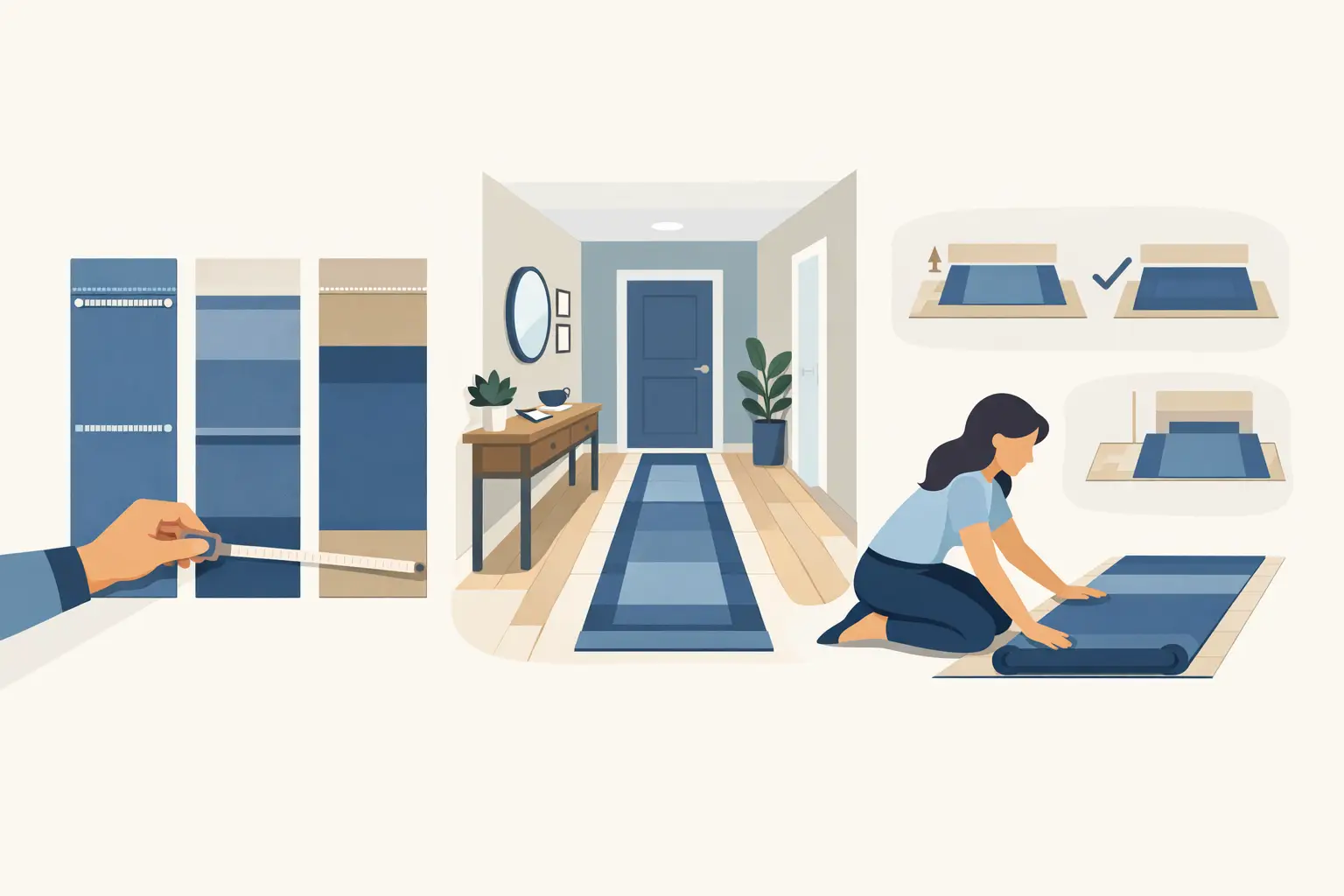
A hallway runner that is even a few inches off can change the entire feeling of a space. Too narrow, and the hall looks unfinished. Too wide, and the runner feels crowded against the walls. This hallway runner size guide is designed to help you get the proportions right so the piece feels intentional, comfortable underfoot, and visually at ease within the architecture of your home.
Hallways ask for a different kind of judgment than living rooms or bedrooms. They are transitional spaces, often tighter, more linear, and more exposed to foot traffic. A runner has to do practical work, but it also sets the tone between rooms. In a well-layered interior, the right runner introduces warmth, color, and quiet character without interrupting the flow of the house.
How to use a hallway runner size guide
The first rule is simple: leave visible floor around the runner. In most hallways, a border of 4 to 6 inches on each side feels balanced. In wider hallways, you can leave a bit more. This margin keeps the runner from pressing awkwardly against baseboards and allows the shape of the hall itself to remain visible.
Length matters just as much. A runner should rarely span wall to wall from one end of the hall to the other. Leaving 6 to 12 inches of exposed floor at each end usually creates a more tailored look. If the hallway is especially long, the larger end margin often looks better because it gives the rug room to breathe.
These are not rigid rules. Older homes, narrow passages, and halls with door swings or floor vents often require adjustment. Good sizing is less about mathematical perfection and more about visual proportion.
Standard hallway runner sizes and what they suit
Most hallway runners fall between 2 and 3 feet wide, with lengths ranging from 6 to 14 feet. The most common sizes work well because they align with the natural proportions of many US homes, but the best fit depends on the actual width and uninterrupted length of your hallway.
A 2′ x 6′ runner is often right for shorter entry corridors, apartment hallways, or small connecting passages. It gives presence without overwhelming a compact footprint.
A 2’6″ x 8′ runner is one of the most versatile options. It suits many standard hallways and tends to feel generous enough underfoot while still leaving a proper floor border.
A 2’6″ x 10′ or 2’6″ x 12′ runner works well in longer central hallways where the goal is to create continuity and softness across a larger stretch of flooring.
A 3′ x 10′ or 3′ x 12′ runner can be beautiful in wider halls, especially in homes with more spacious circulation areas. The extra width feels substantial, but only when the hallway can comfortably support it.
If you are choosing a one-of-a-kind vintage piece, exact dimensions may not mirror standard manufactured sizes. That is often part of the appeal. A handmade runner with slight variation can feel far more considered than a generic standard-size alternative, provided the overall scale is right.
Measure the hallway before you shop
Before looking at color or pattern, measure three things: the full width of the hallway, the full length you want the runner to cover, and any architectural interruptions. That includes doorways, radiators, floor registers, stair landings, and areas where doors open into the hall.
For width, measure from baseboard to baseboard, then subtract 8 to 12 inches total to create a floor border on both sides. For example, if your hallway is 42 inches wide, a runner around 28 to 32 inches wide will usually feel well scaled.
For length, decide whether the runner should anchor the central portion of the hall or extend through most of it. Then leave visible flooring at both ends. If your hall is 12 feet long, a runner around 10 or 11 feet often looks more composed than one that runs the full 12 feet.
Painter’s tape can help here. Mark the outline of a potential runner directly on the floor and live with it for a day. This quick exercise often reveals whether the proportions feel calm or cramped.
Width is where most sizing mistakes happen
People tend to focus on length first, but width is usually what makes a hallway runner feel right or wrong. A runner that is too slim can read like an afterthought, especially in a broader hallway with substantial trim or taller ceilings. One that is too wide can make the space feel visually compressed.
In narrower hallways, a 2-foot-wide runner may be exactly right. In a more generous passage, 2’6″ or even 3 feet wide often feels more grounded. The goal is to create a clear relationship between rug and floor, where both are visible and neither competes.
Pattern also affects perceived width. A runner with a strong central medallion or bold border can appear larger than its measurements suggest. A softly patterned Oushak or worn Persian runner with a gentler field may sit more quietly in the same dimensions.
What to do in extra-long or irregular hallways
Not every hallway fits a standard runner. Some are unusually long, interrupted by turns, or broken up by door openings on both sides. In those spaces, there are two sensible approaches.
The first is to choose one longer runner that covers the primary visual stretch of the hallway and ignore smaller side interruptions. This creates a clean, continuous look. The second is to use two runners with similar tone or character if the hall naturally divides into separate zones.
This is where antique and vintage pieces can be especially useful. Their individuality allows a space to feel collected rather than overly matched. Two runners do not need to be identical to belong together. They only need a shared sense of palette, scale, and texture.
A hallway runner size guide for entry halls and upstairs corridors
An entry hallway usually benefits from a runner with a bit more visual presence. This is the first textile moment in the home, so the size should feel welcoming rather than timid. If the width allows, a slightly broader runner can help establish that sense of arrival.
Upstairs corridors are often narrower and quieter. Here, a runner should soften the passage and connect bedrooms without feeling heavy. A slimmer width and more subdued pattern may feel more appropriate, particularly in homes where the upstairs hall is compact.
In both cases, keep door clearance in mind. A beautiful runner that catches under a door is never the right size, no matter how well the pattern suits the house.
Material, age, and pile affect how a runner lives in the space
Size is not only visual. It also affects function. In a busy hallway, a low-pile vintage wool runner usually performs better than a thicker high-pile option. It sits closer to the floor, allows easier door movement, and tends to feel more integrated with the architecture.
Older handmade runners also bring another quality to a hallway: variation. Slight asymmetry, gentle abrash, and softened borders can make a long passage feel warmer and less rigid. In a home that values collected interiors over perfect uniformity, that character matters.
At Eskici Rugs, this is often the distinction between a runner that simply fills a measurement and one that truly belongs in the space.
When to size up and when to size down
If you are between sizes, the right decision depends on the room’s proportions and what you want the hallway to do. Size up when the hall is wide, open, and visually important. A slightly larger runner can lend confidence and presence.
Size down when the hallway is tight, interrupted by multiple doorways, or visually busy with trim, artwork, or strong flooring. In those cases, more exposed floor can create relief.
This is also where personal preference enters. Some homeowners want the runner to read as a soft, understated layer. Others want it to act almost like a spine through the house. Both approaches can work if the measurements support the intention.
A well-sized hallway runner does not call attention to the math behind it. It simply makes the passage feel finished, warmer, and more considered. When the proportions are right, the eye moves easily, the architecture feels clearer, and the runner becomes part of the home’s rhythm rather than an object placed in its way.
[…] in rooms with high ceilings or multiple seating zones. Yet bigger is not automatically better. A narrow hallway needs a runner with breathing room at either side, while a compact breakfast nook may benefit from […]