
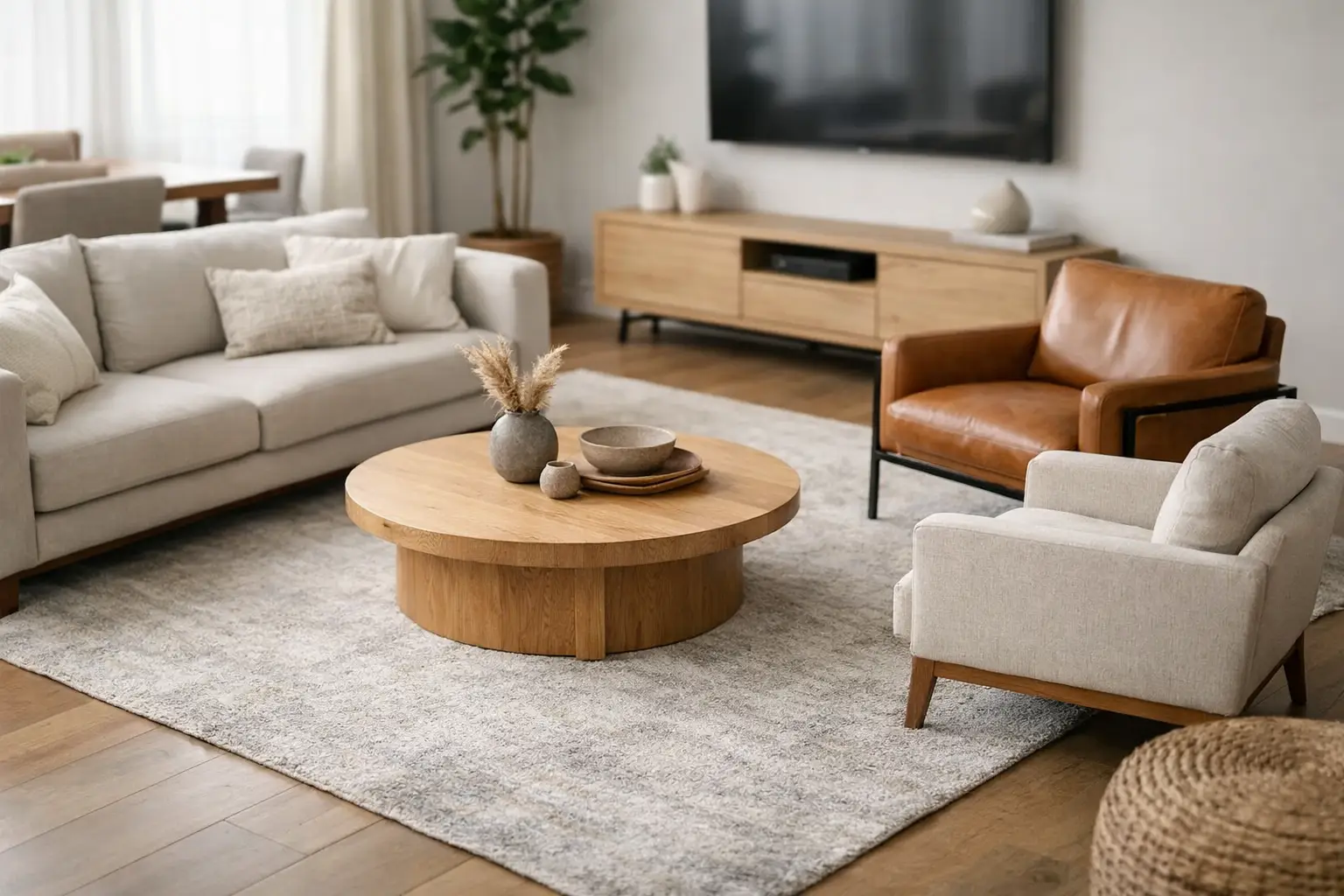
A rug that is too small can make even a well-furnished living room feel scattered. A rug that is too large can flatten the room and leave no breathing space at the edges. The right proportions do more than fill the floor – they give the room structure, bring the seating arrangement into focus, and let the furniture feel intentionally placed. That is the real purpose of a living room rug size guide: not just to match dimensions, but to shape how the room feels.
In design-led interiors, the rug is often the quiet foundation. It holds the coffee table, frames the conversation area, and introduces texture, age, and warmth in a way that paint and upholstery cannot. This matters even more with vintage and handmade rugs, where each piece carries a distinct visual rhythm. Size is what allows that character to read clearly in the room.
How to Use a Living Room Rug Size Guide
The simplest rule is also the most useful: the rug should be large enough to connect the main seating pieces. In most living rooms, that means at least the front legs of the sofa and chairs should sit on the rug. If the rug floats alone in the middle of the room, with furniture fully off its edges, the layout tends to look disconnected.
That said, there is no single correct formula. A formal sitting room, a compact apartment living area, and an open-plan family room all ask for different solutions. The best size depends on the room dimensions, the scale of the furniture, and how much floor you want to show around the perimeter.
As a starting point, leave roughly 8 to 18 inches of visible floor between the rug and the walls. In smaller rooms, the lower end of that range often feels right. In larger rooms, a bit more border can create a calmer frame. If your living room is open concept, the rug may relate more to the furniture grouping than to the walls themselves.
Common Living Room Rug Sizes and What They Suit
An 8×10 rug is often the starting point for a modest living room. It usually works well when a standard sofa faces one or two accent chairs and the front legs of each piece can rest on the rug. This size can also suit apartments or narrower rooms where a larger rug would press too close to the walls.
A 9×12 rug is one of the most versatile choices for a primary living room. It gives the seating area enough footprint to feel established, especially with a full-size sofa, chairs, and a coffee table. If clients ask for the size that most often makes a room feel finished rather than tentative, this is often it.
A 10×14 rug or larger tends to suit expansive rooms, long formal living rooms, or layouts with substantial furniture. In these spaces, a smaller rug can look underscaled very quickly. A larger piece allows the arrangement to breathe while still feeling unified.
If you are considering a one-of-a-kind vintage rug, exact dimensions may not align neatly with standard sizing. That is normal, and often preferable. A handmade rug measuring, for example, 8’7″ x 11’6″ can feel far more nuanced in a room than a strict off-the-shelf format. The goal is proportion, not mathematical rigidity.
Furniture Placement Matters More Than People Expect
There are three common approaches to living room rug placement, and each creates a different effect.
The most balanced option is front legs on, back legs off. The sofa and chairs are visually tied together, but the room still retains some openness at the perimeter. For many homes, this is the sweet spot between generous and practical.
The more expansive option is all legs on. This works especially well in larger rooms where the rug is meant to anchor a full conversation area. It lends a composed, architectural quality, particularly with deeper seating or symmetrical layouts.
The least substantial option is all legs off, where only the coffee table sits on the rug. This can work in very small rooms, but it often makes the rug feel decorative rather than foundational. If the room allows for anything larger, it usually should.
Choosing Rug Size for Different Living Room Layouts
In a compact living room, restraint matters. You do not want the rug to stop short in a way that feels apologetic, but you also do not want it crowded against every edge. An 8×10 often works, especially when paired with apartment-scale seating. If the room is very small, a thoughtfully chosen smaller vintage rug can still succeed, but only if the furniture placement feels deliberate rather than accidental.
In a medium-size living room, a 9×12 is often the size that brings ease. It allows the coffee table to sit comfortably, accommodates the front legs of the major pieces, and creates enough visual field for the rug pattern to be appreciated. This matters with Oushak, Persian, and Sultanabad rugs, where the drawing and color variation deserve room to unfold.
In a large living room, the question is less about filling space and more about defining it. A rug can establish one seating zone within a larger envelope, particularly in homes with open circulation paths or multiple focal points. Here, a 10×14 or an unusually scaled antique piece can help the seating arrangement feel intentional rather than adrift.
Sectionals need special consideration. A rug that only reaches the center of an L-shaped sectional can make the entire arrangement feel top-heavy. In most cases, a larger size is needed so the rug extends beneath the sectional’s front edge and reaches any accompanying chair or ottoman. When in doubt, size up.
What to Measure Before You Buy
Start by measuring the full room, then the seating area itself. The second number is often more useful. You are not simply placing a rug in a room. You are anchoring a furniture composition.
Measure the length and width of the area occupied by the sofa, chairs, and coffee table, including the space the front legs will take up. Then add enough allowance for the rug to extend beyond those points. Painter’s tape on the floor is helpful because it reveals scale in real terms, not just numbers on paper.
Also measure the coffee table. A very large coffee table on a modest rug can crowd the pattern and make the composition feel dense. Likewise, a tiny table floating on an oversized rug may leave the center feeling underfurnished. Good proportion is always relational.
Material, Pattern, and Border Change the Perception of Size
Not all rugs of the same dimensions feel equally large. A pale, open-field rug can make a room feel more expansive. A darker or more intricate rug may read as visually denser, which can be beautiful, but it changes the room’s balance.
Borders matter too. A pronounced border creates a strong frame and can make the rug’s edge feel more defined. In some rooms this is exactly what you want, especially if the rug is acting as a formal anchor. In softer, more layered interiors, an allover pattern or quieter border can feel more integrated.
This is one reason handmade vintage rugs are so compelling in living rooms. Their variation in tone, abrash, and wear gives them depth without visual noise. When the size is right, that character settles naturally into the room rather than competing with it.
When to Break the Rules
There are moments when a less conventional choice makes sense. In a room with exceptional floors, you may want more wood showing around the rug. In a layered interior, a smaller antique rug over a larger natural-fiber base can add texture while preserving generous coverage. In a collected space, asymmetry can feel more alive than strict alignment.
Still, rule-breaking works best when it is clearly intentional. A room should feel edited, not unresolved. If a rug looks too small and the only explanation is that the next size up seemed ambitious, that usually means the next size up was the better choice.
For those furnishing with one-of-a-kind pieces, flexibility helps. At Eskici Rugs, many of the most beautiful living room rugs fall slightly outside standard dimensions, yet fit better because they bring the right visual weight and presence. That is often the advantage of buying with an eye for character rather than standardization.
A living room feels settled when the rug, furniture, and architecture speak to one another in proportion. If you begin there, the room tends to follow.
[…] ones. Measure the room, map the furniture placement, and establish what the rug needs to do. In a living room, it may need to hold the front legs of every major seating piece and create a generous conversation […]